
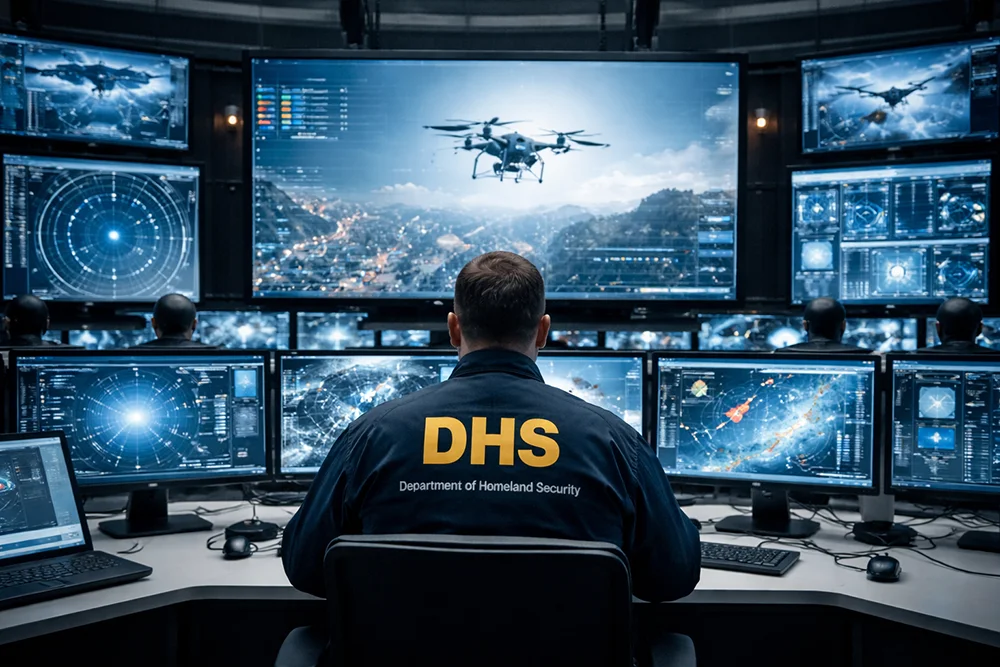
The Department of Homeland Security (DHS) launched a new office to procure and deploy drone and counter-drone technologies. The Program Executive Office for Unmanned Aircraft Systems and Counter-Unmanned Aircraft Systems was created January 12, 2026, and represents a significant operational shift in how the Department will move forward in addressing the evolving drone threat landscape.
Key Developments in Addressing UAS Threats
Immediate Funding Commitment: A $115 million investment in counter-drone technologies is in final stages this week, specifically targeting security for America250 celebrations (the 250th anniversary of the U.S. Declaration of Independence) and 2026 FIFA World Cup venues. Eleven U.S. cities will host 78 matches for the FIFA World Cup in 2026: Atlanta; Foxborough, Mass.; Arlington, Texas; Houston; Kansas City, Mo.; Inglewood, Calif.; Miami Gardens, Fla.; East Rutherford, N.J.; Philadelphia; Santa Clara, Calif.; and Seattle.
This represents the Department’s largest single investment in counter-Unmanned Aircraft Systems (UAS) capabilities to date.
New Organizational Structure: DHS has established a centralized office to strategically procure and deploy drone and counter-drone technologies across Department components. The office is already operational and can be contacted at drones@dhs.gov.
Threat Environment Snapshot
The operational need is clear as current data shows:
- The Federal Aviation Administration (FAA) receives over 100 monthly reports of unmanned aircraft operating near airports.
- The National Football League (NFL) detected approximately 2,300 drones violating game-day Temporary Flight Restrictions around stadiums.
- DHS has conducted over 1,500 counter-drone missions since 2018.
- Cartels actively use drones for cross-border drug trafficking.
- Drones also facilitate criminal activity, such as contraband delivery to correctional facilities.
- As of December 2025, the Law Enforcement Drone Association (LEDA) reported approximately 6,000 police drone programs nationwide.
Expanded Authorities and Capabilities
Legislative Framework: The FY26 National Defense Authorization Act, signed in December, extended DHS and Department of Justice (DOJ) counter-drone authorities through 2031. These powers – first granted in 2018 and temporarily lapsed during last year’s government shutdown – authorize agencies to track, detect, and disable drones deemed threats to public safety.
Broadened Department Authority December 2025 authority expansions now permit all DHS components, plus state, local, tribal, and territorial law enforcement partners and correctional agencies, to fully engage drone threats within their jurisdictions.
Acquisition and Funding Initiatives
Industry Contracting: DHS recently solicited proposals for a new $1.5 billion contract vehicle, enabling components including Customs and Border Protection (CBP) and Immigration and Customs Enforcement (ICE) to rapidly acquire advanced counter-drone technologies.
Grant Distribution: FEMA executed the fastest non-disaster grant award in Department history in December 2025, distributing $250 million in counter-UAS capabilities grants to the 11 states hosting FIFA World Cup 2026 matches and the National Capital Region.
For homeland security professionals, this organizational change signals:
- Centralized procurement may streamline component access to counter-UAS technologies.
- Increased focus on major event security planning for 2026.
- Enhanced interagency and intergovernmental coordination on drone threats.
- Expanded mission sets for components beyond traditional border security operations.