
The State and Treasury Departments announced earlier today, January 13, 2026, that the United States had designated three Muslim Brotherhood chapters as terrorist organizations. This marks the first concrete implementation of President Trump’s Executive Order 14362 to target those Muslim Brotherhood chapters that pose a threat to U.S. national security.
Secretary of State Marco Rubio announced the designations as the opening step in the U.S. government’s sustained campaign to combat the group’s global operations.
The Designations
The State Department has designated the Lebanese Muslim Brotherhood (LMB) – also known as al-Jamaa al-Islamiyah – as both a Foreign Terrorist Organization (FTO) and a Specially Designated Global Terrorist (SDGT). LMB’s secretary general, Muhammad Fawzi Taqqosh, received an individual SDGT designation.
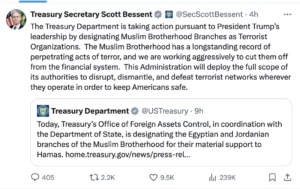
In a coordinated action, the Treasury Department’s Office of Foreign Assets Control (OFAC) designated the Egyptian Muslim Brotherhood and Jordanian Muslim Brotherhood as SDGTs, citing their material support to Hamas.
“The Muslim Brotherhood has inspired, nurtured, and funded terrorist groups like Hamas, that are direct threats to the safety and security of the American people and our allies,” said Under Secretary of the Treasury for Terrorism and Financial Intelligence John K. Hurley.
The designations follow weeks of debate since President Trump issued the executive order on November 24, 2025. At the time, experts weighed in for Homeland Security Today: “CAIR and Muslim Brotherhood: Terrorists or Not? Experts Weigh In on Why – or Why Not – the Groups Should Be Designated Terrorist Organizations,” with some citing the necessary security measures that could follow and others arguing that designation could backfire politically and within communities essential to preventing radicalization.
Lebanon: Rockets and Military Camps
The Lebanese Muslim Brotherhood (LMB) has engaged in direct military operations against Israel. Following Hamas’s October 7, 2023 attack, the group reactivated its al-Fajr Forces, launching rockets into northern Israel in coordination with Hezbollah and Hamas. In March 2024, Israeli Defense Forces attacked al-Fajr Forces operatives preparing to carry out terrorist attacks against Israel. In July 2025, Lebanese Army forces dismantled a covert military training camp housing both LMB and Hamas militants.
Under Taqqosh’s leadership, the LMB has pursued closer alignment with what officials call the “Hezbollah-Hamas axis.”
Egypt and Jordan: Support Networks for Hamas
Evidence presented by the Treasury Department reveals extensive operational support networks by the Muslim Brotherhood to Hamas. As of 2025, the Egyptian Muslim Brotherhood (EMB) coordinated with Hamas on potential terrorist activities against Israeli interests. In mid-2025, Hamas’s military wing worked with the EMB to destabilize the Egyptian government, providing funding for these efforts.
The EMB also served as a pipeline for foreign fighters. According to Treasury officials, individuals seeking to fight for Hamas in Gaza required Muslim Brotherhood connections. Once in Egypt, these fighters used Brotherhood networks to enter Gaza, with the organization keeping Hamas informed of their movements and arrival times.
The Jordanian Muslim Brotherhood (JMB), officially dissolved by court order in 2020, has continued underground operations. Since early 2025, elements connected to the JMB have been implicated in terrorism cases involving rocket manufacturing, explosives production, drone assembly, and recruitment operations, funded through illegal means.
Historical Context of the Muslim Brotherhood
As described by the Counter Extremism Project, the Muslim Brotherhood is a transnational Sunni Islamist movement, founded in Egypt in 1928, that seeks to implement sharia (Islamic law) under a global caliphate. The group has already been labeled a terrorist
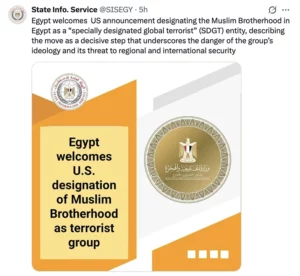
organization by the governments of Bahrain, Egypt, Russia, Saudi Arabia, Syria, and the United Arab Emirates.
The designations come amid longstanding concerns about Muslim Brotherhood and its offshoots. Hamas itself described its relationship to the Brotherhood in its 1988 founding charter, calling itself “a wing of the Muslim Brotherhood in Palestine.”
Several other violent Brotherhood offshoots have previously received U.S. terrorist designations, including Egyptian Islamic Jihad (led by Ayman al-Zawahiri before merging with al-Qaeda), Palestinian Islamic Jihad, and more recent groups like Harakat Sawa’d Misr (HASM) and Liwa al-Thawra.
HASM, formed in 2015, conducted numerous attacks, including the 2016 attempted assassination of Egypt’s former Grand Mufti Ali Gomaa and a 2019 car bombing outside a Cairo hospital that killed at least 20 people. Liwa al-Thawra was responsible for the 2016 assassination of Egyptian brigadier general Adel Ragai and a 2017 bombing of a police training center in Tanta, Egypt.
Financial and Legal Consequences
The additions as an individual or entity to the special designated nationals list triggers financial and other restrictions: All property and interests in property belonging to the designated entities within U.S. jurisdiction are blocked. U.S. persons are prohibited from conducting business with these organizations.
Foreign financial institutions face potential secondary sanctions if they knowingly conduct significant transactions on behalf of the designated groups. Treasury Secretary Scott Bessent emphasized the administration’s commitment to cutting the Muslim Brotherhood off from the financial system.
Violations of these sanctions can result in civil or criminal penalties on both U.S. and foreign persons, with OFAC able to impose civil penalties on a strict liability basis.
Ongoing Campaign
Officials characterized Monday’s action as the beginning of a broader effort. Rubio’s statement explicitly described these as “the opening actions of an ongoing, sustained effort to thwart Muslim Brotherhood chapters’ violence and destabilization wherever it occurs,” suggesting additional designations may follow.