
The rapid expansion of unmanned aircraft systems (UAS), commonly known as drones, has transformed aviation and introduced new opportunities across nearly every sector of society. Public safety, corrections, critical infrastructure, utilities, security, service delivery, construction, real estate, cinematography, agriculture, transportation, aviation, advanced air mobility (AAM), counter-UAS (cUAS), marine biology, and countless other industries are increasingly relying on drone technology to improve efficiency, safety, and operational effectiveness.
This growth, however, is creating a new challenge: integrating an unprecedented number of aircraft into the National Airspace System (NAS).
A Fundamental Shift in Aviation
According to the FAA Civil Aircraft Registry, there are approximately 230,000 active registered traditional aircraft in the United States, including airliners, business jets, helicopters, agricultural aircraft, and general aviation aircraft.
By comparison, the FAA reports nearly one million registered drones nationwide.
The growth within public safety is particularly noteworthy. While there are approximately 300 traditional public safety aviation programs operating manned aircraft, there are now more than 10,000 public safety drone programs across the country. This dramatic shift represents one of the most significant changes in aviation since the introduction of helicopters into public safety operations.
FAA Civil Aviation Statistics for 2025 indicate there are approximately 900,000 certificated traditional aircraft pilots and nearly 500,000 certificated remote pilots. Notably, the pace of remote pilot certification continues to outpace the growth of traditional pilot certifications, demonstrating the accelerating adoption of drone technology.
The Rise of Drone as a First Responder
One of the most significant developments in public safety aviation has been the emergence of Drone as a First Responder (DFR) programs.
Following FAA regulatory changes that simplified and expedited approvals in May 2025, DFR adoption has accelerated dramatically. Approved DFR waivers increased from approximately 50 approvals over six years to more than 1,000 approvals in just six months. Today, the FAA is averaging approximately 125 new DFR waiver approvals each month.
These operations are particularly important because they involve remote flights conducted Beyond Visual Line of Sight (BVLOS), allowing drones to respond rapidly to incidents before ground units arrive.
Based on current DFR operational data and approved procedures, the FAA has determined the risk of collision between drones and traditional aircraft to be extremely low—approximately 10⁻⁷, or one in ten million.
The Emerging Challenge: Drone-to-Drone Conflict
While the risk of drone-to-manned-aircraft collisions remains exceptionally low, another challenge is emerging: drone-to-drone interactions.
Drone activity is increasing at a pace never before experienced in aviation. According to the FAA, drone service delivery operations are approaching one million successful deliveries in the United States. At the same time, public safety agencies continue expanding DFR operations into urban, suburban, and rural environments.
The issue is that these operations will increasingly occupy the same airspace.
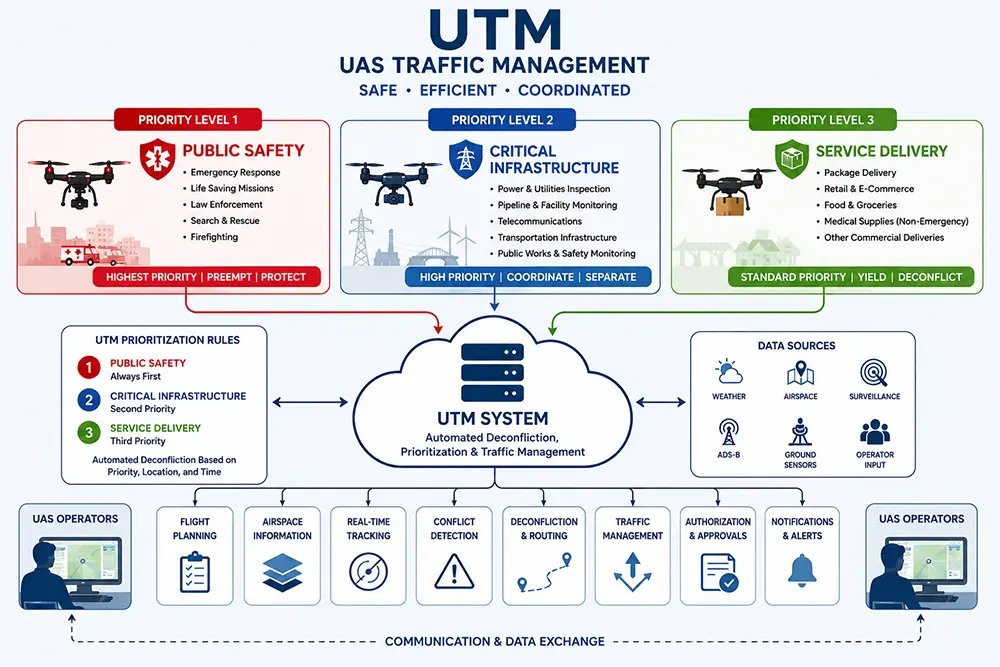
Today, only limited testing has been conducted regarding prioritization between public safety operations and commercial service delivery flights. As both sectors continue to grow, coexistence will require new methods of coordination, deconfliction, and operational prioritization.
Compounding this challenge is the reality that UAS Traffic Management (UTM) systems remain in the early stages of development. While significant progress is being made, many of the processes, technologies, governance structures, and business models necessary for large-scale integration are still under development.
Critical Questions That Must Be Answered
As public safety agencies continue adopting DFR and BVLOS operations, it is essential that they begin preparing now for integration into future UTM environments.
While there are questions to be answered, the need for UTM and prioritization are necessary NOW and without prioritization will decimate the life saving capabilities of DFR programs which are expanding exponentially across the U.S.
Looking Ahead: Part 108 and Increased Airspace Complexity
The challenge of integration will become even more significant as the FAA prepares to publish its Final Part 108 BVLOS Rule.
Part 108 is expected to dramatically expand BVLOS operations across multiple sectors, introducing additional commercial, industrial, and public safety aircraft into the NAS. As a result, airspace management will become increasingly complex, making coordination, prioritization, and safety assurance more important than ever before.
Building a Strong Aviation Safety Culture
While industry-wide solutions continue to evolve, there are immediate actions every public safety drone program can take.
Organizations should focus on building and maintaining a strong aviation safety culture by emphasizing:
● Remote Pilot Certification compliance
● Recurrent training programs
● Crew Resource Management (CRM) procedures
● Aircraft maintenance and airworthiness programs
● Operational risk assessments
● Standard operating procedures
● Comprehensive recordkeeping and documentation
These foundational elements not only improve operational safety but also prepare agencies for future integration into increasingly sophisticated airspace management systems.
Collaboration Is the Path Forward
Recognizing the importance of this issue, DRONERESPONDERS has begun discussions with the Service Delivery Cohort, which includes major drone delivery companies and the FAA. The goal is to establish a formal collaboration focused on developing a roadmap for safe, scalable integration through successful implementation of UAS Traffic Management.
The future of public safety aviation depends on ensuring that emergency response drones, commercial service delivery operations, and other BVLOS users can safely share the same airspace.
The time to begin that work is now.
For agencies and organizations interested in participating in these discussions and learning more about the future of UTM and public safety integration, visit the DRONERESPONDERS Advanced Air Mobility Working Group.