
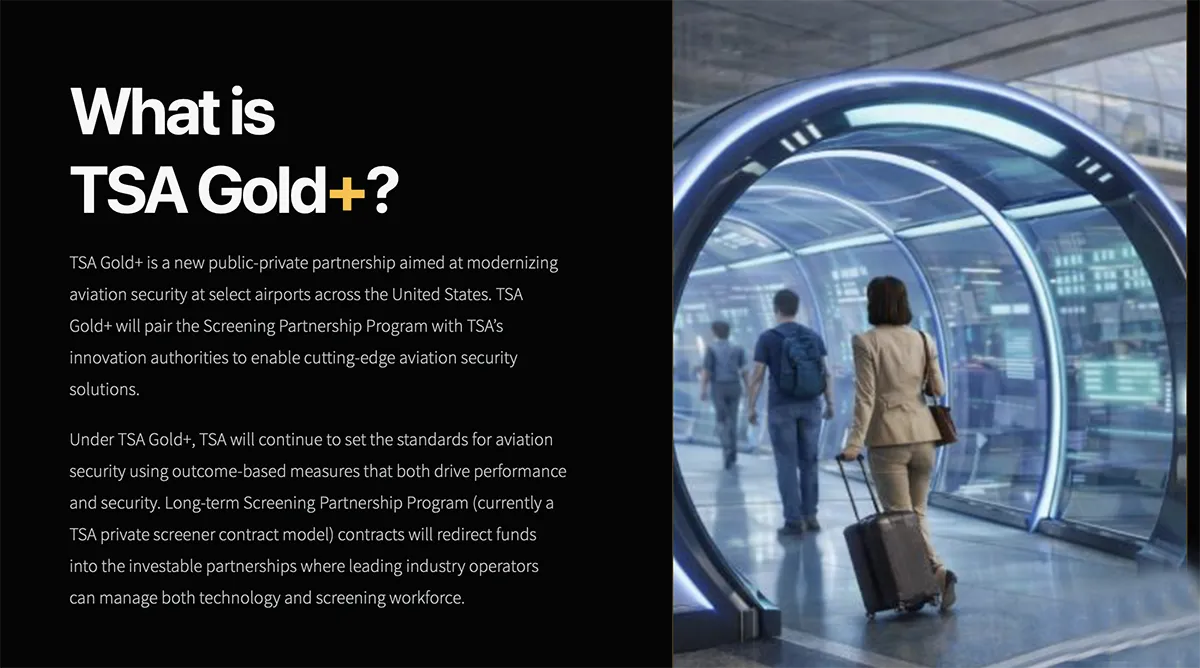
The Transportation Security Administration (TSA) has taken its most concrete step yet toward formalizing its “TSA Gold+” public-private partnership model, releasing a pre-solicitation notice on SAM.gov on May 15, 2026, that includes a draft Performance Work Statement, evaluation factors, and an invitation to an Industry Day scheduled for May 21 at TSA headquarters in Springfield, Virginia.
The notice, which carries a response deadline of May 25, describes Gold+ as “a transformative initiative to modernize aviation security at select U.S. airports through robust public-private partnership” and calls for integrated, outcome-based contracts covering workforce, technology, and maintenance, all under TSA regulatory oversight. The program is voluntary and opt-in for airports.
What Gold+ Would Change and What It Wouldn’t
Gold+ builds on the existing Screening Partnership Program (SPP), under which TSA-approved private contractors currently employ screeners at 20 of the more than 430 U.S. airports with scheduled passenger service. San Francisco International and Kansas City International are among the larger airports in SPP; most participants are small regional airports.
The key distinction between the current SPP model and Gold+ is the scope of contractor responsibility. Under SPP, TSA owns and procures screening equipment while contractors provide the workforce. Under Gold+, contractors would manage both the workforce and the technology, including procurement, deployment, lifecycle refreshes, and maintenance of checkpoint and checked baggage screening systems. TSA would retain regulatory oversight, set security standards, conduct inspections and audits, and certify all screening equipment and procedures.
TSA training standards, performance testing, and evaluations would remain federal functions under the program framework. Airports that do not opt in would continue operating under standard TSA arrangements.
The Procurement Framework
The draft evaluation factors released alongside the pre-solicitation offer the clearest public picture yet of how Gold+ contracts would be structured. TSA is planning an Indefinite Delivery/Indefinite Quantity (IDIQ) vehicle at the base contract level, with airport-specific task orders issued beneath it.
At the IDIQ level, proposals would be evaluated across six factors: Technology Solution and Innovation; Staffing and Workforce Management; Performance and Outcome Management; Management Approach and Transition Plan; Financial Capability and Business Stability; and Past Performance and Relevant Experience.
The technology factor requires offerors to describe proposed checkpoint and checked baggage systems, lifecycle and refresh strategies, real-time performance dashboards for TSA oversight, and open architecture approaches to ensure interoperability with evolving TSA systems. TSA says proposals relying on “speculative or undeveloped technologies without a credible deployment plan will be rated lower.”
The workforce factor asks for detailed staffing models by function – including Transportation Security Officer (TSO) equivalents, supervisors, and maintenance personnel – along with passenger-to-officer ratios, surge staffing plans, and hiring, vetting, and training processes. TSA would retain authority over recurrent training and detection skill standards.
Notably, the financial capability factor requires bidders to demonstrate sufficient capitalization to sustain a 10-year integrated contract, a signal that TSA is seeking financially durable partners, not short-term vendors.
For airport-specific task orders, offerors would need to tailor proposals to individual airports’ layouts, traffic patterns, and community roles, and demonstrate that their total proposed price does not exceed the government’s cost to provide equivalent federal screening services. TSA would provide a federal staffing cost baseline for each airport.
Context: Budget Pressures and Prior Controversy
TSA’s interest in expanded privatization is not new. The Trump administration’s fiscal year 2027 budget proposal calls for shifting all Category III and Category IV airports – the smallest airports in TSA’s categorization system, representing roughly 60 percent of airports with scheduled service – into the existing SPP model. According to TSA’s own congressional testimony, the FY2027 budget includes a $477 million increase in SPP funding, offset by a roughly $529 million reduction in TSO personnel costs, for a projected net savings of approximately $52 million.
Gold+ goes beyond that proposal, targeting select airports of unspecified size with a more expansive privatization structure that includes technology ownership.
TSA has faced significant fiscal pressure for years. Passenger volume has grown roughly 28 percent over the past decade – TSA screened 906 million passengers in 2025, while it screened over 708 million passengers in 2015 – while the officer workforce has grown a little over 8 percent. Equipment maintenance costs have roughly doubled, and a 30 percent pay raise for TSOs awarded in 2023 as part of the omnibus funding bill further strained the budget. The agency’s schedule for replacing legacy baggage screening machines with computed tomography equipment is projected to stretch to the 2040s. TSA officials have framed Gold+ partly as a mechanism to accelerate that refresh cycle by bringing in private capital outside the federal budget process.
The two recent government shutdowns also reinforced interest in privatization: screeners at the 20 SPP airports were unaffected because their contracts are pre-funded and not subject to annual appropriations.
What Comes Next
The Industry Day on May 21 will feature presentations from TSA leadership, a review of statutory and contracting frameworks, discussion of evaluation criteria, and breakout sessions for direct engagement. Registration closes May 18, with a maximum of two representatives per company.
Written feedback on the draft Performance Work Statement and evaluation factors is due by May 25. TSA has indicated it will use that input before issuing a formal solicitation, though no solicitation date has been announced.