
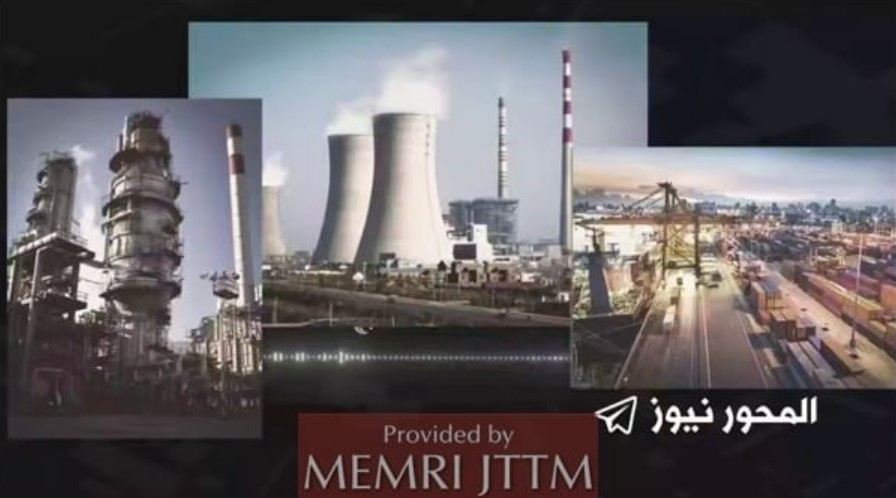
A report by the Middle East Media Research Institute’s Jihad and Terrorism Threat Monitor (JTTM) project focused on a video posted May 12 by a pro-Iran Telegram channel. The video warned that attacks on Iranian infrastructure would be immediately met with similar attacks against enemy infrastructure. Below is the report.
On May 12, 2026, the “ALMIHWAR NEWS” Telegram channel, which is aligned with the Iran-backed Islamic resistance axis, shared a two-minute propaganda video warning that regional stability is conditional upon “respecting borders and critical infrastructure,” and that any attack on Iranian infrastructure would be answered by a similar attack on enemy infrastructure. This, stressed the video, is within Iran’s right to self-defense, adding that Iran had made it clear that it is not interested in conflict, but retains the right to defend itself.
The video contains excerpts from a March 31 statement by Iranian Foreign Minister Abbas Araghchi in which he warned that the security of Iranian energy is a red line and that any country in the region that assists in attacks against Iran’s “oil and steel arteries” will “bear direct responsibility for the consequences of Iran’s defensive response.”
Mentioning cyberwarfare, the video called “cyberterrorism” against Iran’s banking system “a direct attack against the daily life of the public” and that paralyzing financial systems in technological and financial centers in the region by Iran would therefore constitute “a defensive measure” meant to “reveal the high price of modern terrorism.” Iran’s attacks on infrastructure targets are therefore part of “a coordinated and joint-network defensive array,” it said, adding that bombing cities and bridges in Iran would give the Iran-backed “resistance front” grounds to exercise their legitimate right to self-defense. Furthermore, it said that Iran only attacks ports and airfields after repeated warnings aimed at clarifying to the aggressors that “security in the region cannot be divided – there will either be security for everyone, or for no-one.”
Moreover, the video said that Iran’s military capabilities were designed not for offensive operations but for preventing wars – but that when Iranian bases and defense systems are attacked, then “the response against the military bases of the attacker are an inherent right in the context of legitimate defense.” It elaborated that these measures are not meant to expand the scope of the conflict, but rather to “restore balance and achieve deterrence,” as well as to send the enemy a clear message that “any military operation will have an immediate and proportional cost.”
The video includes still images of the aftermath of attacks on Iranian infrastructure along with images of the aftermath of recent Iranian attacks on infrastructure, military, and civilian targets in neighboring countries.
Visit the MEMRI Jihad and Terrorism Threat Monitor page here.