
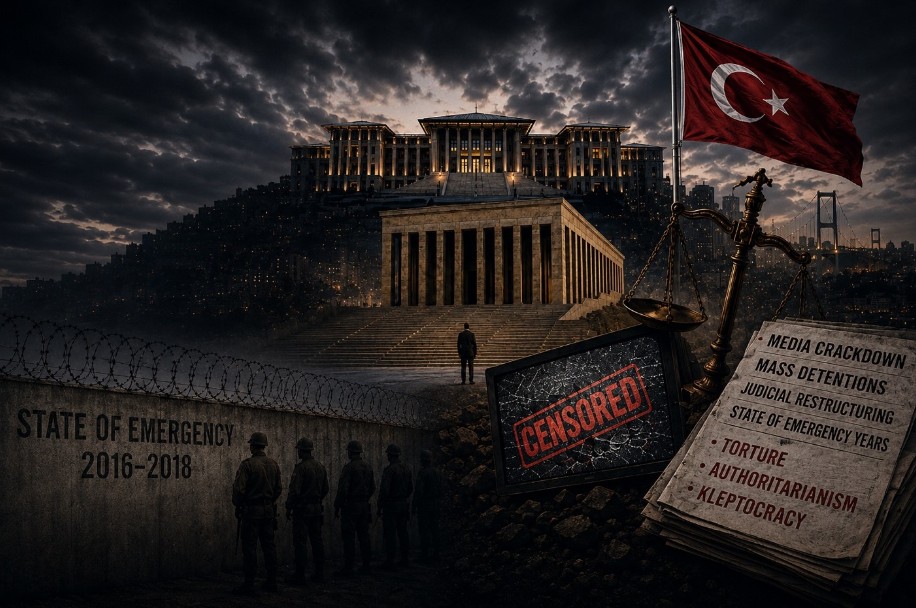
If the first battle on July 15 concerned control of the state, the second concerned control of its meaning. The failed 2016 coup attempt did not simply end with the defeat of the so-called plotters. It inaugurated one of the most transformative periods in the history of the Turkish Republic. In the years that followed, military institutions were restructured, hundreds of thousands of individuals were investigated and purged, media pluralism narrowed, and the boundaries between national security and political opposition blurred.
As the final installment of this three-part series (read Part I & Part II here) marking the tenth anniversary of July 15, this article addresses the remaining four questions and considers the aftermath of the coup attempt. It examines how the Turkish military was reshaped, how new political enemies were constructed, how repression extended beyond Türkiye’s borders even as dissenting voices at home were increasingly silenced, and what broader lessons democracies can draw from the Turkish experience. Together, these final four answers suggest that the true significance of July 15 lies not only in the unresolved debates over what happened that night but also in the profound consequences that followed and continue to shape Türkiye a decade later.
Question 7. How Did July 15 Reshape the Turkish Military?
The July 15, 2016 coup attempt triggered a profound and far-reaching transformation of the Turkish Armed Forces, extending well beyond a conventional post-crisis security response. In the immediate aftermath, the military underwent extensive restructuring, including mass dismissals, institutional redesign, and a reconfiguration of the command architecture. This process significantly affected institutional autonomy, professional continuity, and the long-standing organizational structure of the armed forces.
One of the most visible effects was the large-scale disruption of the chain of command. According to official state records, 8,651 military personnel participated in the July 15 coup attempt, including 1,676 privates and noncommissioned officers and 1,214 military students. The Ministry of National Defense reported that these individuals accounted for approximately 1.5 percent of the Turkish Armed Forces. In the aftermath, however, the response far exceeded the scope of those directly implicated. More than 150 generals and admirals, along with tens of thousands of officers, noncommissioned officers, cadets, and civilian personnel, were dismissed, detained, or placed under investigation. By 2025, official figures indicate that over 20,000 personnel had been dismissed and more than 60,000 were subject to judicial or administrative proceedings. These purges were unprecedented in modern Turkish history and surpassed the scale of personnel removals following earlier coups or interventions.
This restructuring had significant consequences for military capacity and institutional memory. Entire segments of the officer corps were removed, including highly experienced personnel in key branches such as the Air Force, where hundreds of trained pilots were dismissed. Critics argue that this led to a decline in operational readiness, particularly as the pilot-to-aircraft ratio fell sharply. The effects were especially pronounced in the Air Force, where approximately 850 experienced pilots were dismissed. A significant share of these personnel had been trained on F-16 and F-4 combat aircraft and possessed extensive operational experience. Following these dismissals, the pilot-to-aircraft ratio reportedly declined from approximately 1.5–2.5 pilots per aircraft to around 0.8, a level widely interpreted as indicative of operational strain. Critics further note that only a relatively small number of pilots, estimated at approximately 10 to 15 individuals, were directly implicated in coup-related incidents, whereas a far larger number of qualified pilots were subsequently removed from service. From this perspective, the extensive dismissals had disproportionate effects on operational readiness and reflected a broader political decision to prioritize regime consolidation over military effectiveness. Across all branches, the removal of experienced officers is widely seen as weakening doctrinal continuity, accumulated expertise, and institutional cohesion.
In parallel, the military education system was fundamentally redesigned. Military high schools, war academies, and non-commissioned officer preparatory schools were closed, and about 16,500 military students were removed from the system. These institutions were later consolidated under the National Defense University, which operates under civilian oversight. Although presented as a modernization effort, this restructuring disrupted long-established pathways for military socialization, merit-based selection, and professional development.
The reforms also extended to recruitment and promotion systems. Previously standardized, exam-based, and merit-oriented mechanisms were gradually replaced by more informal networks of affiliation and endorsement. Critics argue that this shift increased the influence of political and ideological loyalty in personnel decisions, contributing to a patronage-based structure that undermined meritocracy in the armed forces.
Institutional fragmentation further reshaped the military’s structure. The Land, Naval, and Air Forces were brought more directly under the Ministry of National Defense, while the Gendarmerie and Coast Guard were transferred to the Ministry of Interior. Although intended to strengthen civilian oversight, this reorganization altered the traditional unified command structure and raised concerns about diminished operational coordination.
Finally, strategic defense decisions in the post-coup period also had long-term implications. Türkiye’s acquisition of the Russian S-400 system led to its exclusion from the F-35 program, and delays in F-16 modernization further constrained air force capabilities. Taken together with broader institutional changes, these developments affected NATO interoperability and long-term defense planning.
Question 8. How Did the Post-Coup Environment Create New Political Villains?
One of the most consequential developments following the July 15 coup attempt was the transformation of the Gülen movement into the principal internal enemy of the Turkish state. This shift was particularly striking given the close relationship that had existed between the AKP government and the movement during the party’s first decade in power. Many AKP politicians maintained close ties with Gülen-affiliated institutions, and the children of numerous AKP officials, including members of President Erdoğan’s family, attended schools associated with the movement. The relationship began to deteriorate after the December 17–25, 2013 corruption investigations, which targeted money launderers who violated U.S. sanctions against Iran. Erdoğan described the probes as a judicial coup attempt orchestrated by Gülen-affiliated police officers and prosecutors. The investigations, which relied on wiretaps, financial records, and other solid evidence, led to corruption allegations against several cabinet ministers and individuals close to the government. Erdoğan rejected the investigations as politically motivated and subsequently launched a broad campaign against individuals believed to be associated with the movement.
After July 15, this process accelerated dramatically. In the decade that followed, Fethullah Gülen and his followers were systematically portrayed as existential threats to Türkiye’s security, democracy, and national unity. Through this process, the category of “Gülenist” expanded far beyond those directly implicated in the events of July 15 to include teachers, judges, journalists, academics, civil servants, and ordinary citizens accused of association with the movement. Public discourse increasingly framed Gülenists as traitors who had allegedly infiltrated state institutions to destroy the country from within. The movement’s demonization enabled the government to justify extraordinary measures, consolidate political power, and redefine political opposition in the language of national security.
Over time, accusations of affiliation with the movement extended well beyond its actual members or sympathizers. Opposition politicians and party members, government critics, journalists, and civil society actors were at times labeled Gülenists or accused of acting on behalf of the organization. Similar accusations were occasionally directed at foreign actors, including members of the European Parliament, U.S. policymakers, former intelligence and law enforcement officials, and other international figures who criticized the Turkish government’s post-coup policies. Domestically, individuals facing criminal investigations frequently claimed that the police officers, prosecutors, or judges involved in their cases were linked to the movement, further reinforcing the perception that Gülenists were responsible for a broad range of political and legal disputes. As a result, the term increasingly evolved from a description of a specific movement into a highly flexible political label used to delegitimize critics and opponents. In this respect, the post–July 15 environment resembled a prolonged political witch hunt in which accusations of Gülenist affiliation became a powerful instrument for marginalizing dissent and shaping public perceptions.
The scale of the response was unprecedented in modern Turkish history. During the state of emergency declared after the coup attempt, more than 125,000 public servants were permanently dismissed, hundreds of educational institutions, foundations, associations, and media organizations were shut down, and nearly 100,000 security operations targeting alleged Gülenists were conducted. Tens of thousands of people were detained or imprisoned; many were tortured, and many women were harassed. More than 230,000 passports were canceled. The campaign extended beyond Türkiye’s borders through the rendition of alleged movement members from foreign countries and efforts to transfer Gülen-affiliated schools abroad to state-controlled institutions. Significantly, major opposition parties also offered limited resistance to these measures, helping normalize an extraordinary expansion of state power. By portraying the Gülenists as a permanent and existential threat, the government was able not only to legitimize mass purges and restrictions on civil liberties but also to reshape the political system itself. In this sense, the construction of the Gülenists as political villains became both a symbol and a mechanism of Türkiye’s post–July 15 authoritarian transformation.
Question 9. How Did July 15 Extend Repression Beyond Borders and Silence Dissent at Home?
The post–July 15 period marked a significant expansion of the Turkish state’s coercive capacity, both domestically and internationally. Beyond the mass purges and institutional restructuring inside Türkiye, the government increasingly sought to pursue critics, journalists, and alleged Gülenists outside its borders. One of the most controversial aspects of this strategy involved the use of international policing mechanisms. Between 2016 and December 2025, Türkiye submitted 3,579 Red Notice requests to Interpol targeting alleged members of the Gülen movement. Although many of these requests were rejected under Article 3 of the Interpol Constitution, which prohibits politically motivated interventions, Turkish authorities continued to rely on Red Notices, diffusions, and informal channels to locate and pressure exiled opponents. European courts increasingly refused extradition requests, citing concerns over torture, unfair trials, and the political nature of the accusations. As a result, Türkiye came to be viewed by many human rights organizations as a prominent example of transnational repression, extending domestic authoritarian practices into the international arena.
At the same time, dissent within Türkiye was systematically constrained through the transformation of the media landscape. More than 170 media outlets—including newspapers, television channels, radio stations, publishing houses, and news agencies—were closed under emergency decrees, and over 150 journalists were imprisoned on charges often linked to terrorism or alleged organizational membership. Independent and critical voices faced intimidation, regulatory pressure, advertising bans, and digital censorship. Ownership structures increasingly shifted toward pro-government conglomerates, and media regulators expanded their oversight powers. Even opposition media largely avoided investigating politically sensitive subjects surrounding July 15, contributing to a climate of self-censorship. By controlling the domestic flow of information and pursuing critics abroad, the government institutionalized a new model of governance in which loyalty became a prerequisite for participation in public life, and dissent was increasingly framed as a security threat. In this sense, the post–July 15 period not only reshaped Türkiye’s political landscape but also demonstrated how authoritarian practices can transcend national borders while narrowing the space for free expression at home.
Question 10. What Lessons Should Democracies Learn from July 15?
The first lesson of July 15 is that fragile democracies can be destroyed not only by successful military coups but also by crises that are manipulated, constructed, or strategically exploited. Regardless of how one ultimately interprets the events of that night, the aftermath fundamentally transformed Türkiye’s political system. A country once presented as a model showing that Islam and democracy could coexist gradually moved away from liberal democratic norms and toward increasingly centralized and authoritarian governance. Decades of Westernization, Europeanization, and institutional development were reversed. Institutions designed to constrain power—including the judiciary, parliament, the military, universities, and the media—were weakened, politicized, or subordinated to executive authority. The Turkish experience demonstrates that democracies often collapse not only through tanks but also through narratives that justify dismantling institutional safeguards in the name of protecting the state.
A second lesson concerns the relationship among corruption, fear, and authoritarian survival. Political leaders who fear losing power may resort to extraordinary measures to preserve their position. In Türkiye, the December 17–25, 2013, corruption investigations, which implicated high-level AKP ministers and politicians, marked a critical turning point, threatening the legitimacy and political future of the ruling elite. In the years that followed, especially after July 15, the state increasingly mobilized its legal, bureaucratic, and security apparatuses to reshape public perception and manufacture consent. Through propaganda, selective prosecutions, and emotionally charged narratives of national survival, millions of citizens were persuaded to accept explanations that often lacked support from transparent investigations. The politics of fear replaced the politics of accountability.
The Turkish experience also shows how authoritarian consolidation can accelerate the transition from corruption to kleptocracy. Before the July 15 coup attempt, corruption had already become a defining political issue, particularly after the December 17–25, 2013 investigations. While Türkiye scored 49 on Transparency International’s Corruption Perceptions Index in 2012 and 50 in 2013, its score steadily declined to 41 in 2016 and 31 by 2025 as institutional oversight weakened following the coup attempt and the transition to an executive presidency. The concentration of political power enabled politically connected bureaucrats, politicians, and business elites to benefit from public procurement, preferential contracts, and weakened accountability mechanisms. Corruption increasingly evolved from isolated misconduct into a systemic form of governance resembling kleptocracy, imposing substantial economic costs through declining investor confidence, the depreciation of the Turkish lira, persistently high inflation, and growing poverty.
The third lesson is that terrorism can be instrumentalized for political purposes. Since the July 15, 2016 coup attempt, anti-terrorism rhetoric has expanded dramatically, reaching far beyond individuals directly implicated in acts of violence. Between July 2016 and the end of 2023, more than 2.2 million terrorism investigations were reportedly launched in Türkiye, even though, during roughly the same period, the U.S. Department of State’s terrorism database recorded only 434 terrorist incidents in the country, the overwhelming majority of which were attributed to the PKK and ISIS. Moreover, throughout this period, the U.S. government’s annual Country Reports on Terrorism consistently refrained from designating the Gülen movement as a terrorist organization, highlighting the divergence between Ankara’s expansive domestic counterterrorism framework and the assessments of one of its principal NATO allies. Teachers, judges, journalists, military officers, academics, civil servants, opposition figures, and ordinary citizens were labeled security threats. Entire families became targets of suspicion. Children faced social exclusion because of their parents’ alleged affiliations. Millions lost jobs, passports, careers, reputations, and opportunities. Dreams built over generations were destroyed by guilt-by-association and the criminalization of dissent. Counterterrorism, originally intended to protect society from violence, became intertwined with broader political objectives.
A fourth lesson is the importance of pluralism and independent institutions. Opposition parties were weakened by judicial pressure and political stigmatization, while the media landscape was reshaped by closures, arrests, forced ownership changes, and self-censorship. Investigative journalism increasingly gave way to the repetition of official narratives, narrowing public debate and reducing society’s ability to scrutinize those in power. As institutional independence eroded, the capacity to investigate abuses, hold leaders accountable, and correct policy failures diminished significantly.
A fifth lesson concerns the international dimension of authoritarianism. The post–July 15 experience illustrates how governments can use diplomacy, international organizations, security partnerships, and law enforcement mechanisms to advance domestic political objectives. Through extradition requests, Interpol notices, diplomatic pressure, and bilateral negotiations, the Turkish government sought to secure international support for its post-coup narrative and to pursue opponents abroad. These developments demonstrate that authoritarian practices increasingly transcend national borders, extending political repression beyond the state’s territorial boundaries.
Ultimately, the most enduring legacy of July 15 may not be the failed coup attempt itself, but the political order that emerged in its aftermath. Over the decade that followed, military institutions were fundamentally restructured, judicial and media independence weakened, counterterrorism powers expanded, and political opposition increasingly associated with questions of loyalty and national security. More than 2.2 million terrorism-related investigations, the purging of hundreds of thousands of individuals, and the disruption of countless personal and professional lives illustrate how extraordinary crises can be used to justify extraordinary concentrations of power.
Whether July 15 was a genuine coup attempt, a constructed crisis, or an event strategically exploited by those in power will likely remain a matter of debate. What is less disputed is that its aftermath accelerated Türkiye’s authoritarian trajectory, weakened institutions built over decades, undermined the rule of law, and diminished the country’s reputation as a model for reconciling Islam and democracy. The Turkish experience offers a broader lesson for democracies everywhere: democratic systems can be undermined not only by tanks on the streets but also by fear, polarization, corruption, emergency narratives, and the concentration of power in leaders fearful of losing office. Democracy remains the most effective safeguard for human rights, accountability, institutional integrity, and the rule of law. The tragedy of July 15 lies not only in the lives lost that night but also in the democratic promise, institutional resilience, and hopes of millions that were lost in the decade that followed.