


The Misunderstood Environment
Video games are often perceived as benign spaces designed for entertainment, leisure, and, in many cases, children. This perception is reinforced by their association with play, storytelling, and escapism, leading policymakers, security professionals, and parents to treat gaming environments as fundamentally different from social media or other digital platforms of concern. As a result, gaming has been viewed as adjacent to risk rather than embedded within it.
That assumption no longer holds.
Modern gaming platforms are persistent, networked social environments that integrate communication, content creation, and identity formation at scale. They function similarly to social media, but with greater immersion.1 Players are not simply consuming content. They interact in real time, form relationships, build communities, and participate in shared narratives that shape how they see themselves and others.
This distinction matters. Unlike social media, where users passively scroll, gaming requires active participation within immersive systems. Individuals do not just encounter narratives. They experience them, make decisions within them, and internalize roles tied to those narratives.2 The boundary between entertainment and influence becomes blurred.
For practitioners, the risk lies in the gap between perception and reality. When gaming is treated as harmless or separate from the broader information environment, it creates a blind spot in detection, policy, and intervention. In one case, a young hacker traced his pathway into cybercrime to gaming platforms like Roblox, where early exposure to cheating communities evolved into participation in hacking forums that normalized illicit behavior.3 What began as curiosity escalated into high-impact cybercrime, reinforced by communities offering status, mentorship, and recruitment pathways. Extremist and criminal groups have recognized and exploited this gap, leveraging gaming environments where social interaction, identity exploration, and narrative immersion converge.
Understanding gaming as a participatory part of the digital ecosystem is the first step. The question is no longer whether gaming can be exploited, but how it is already being used and how quickly practitioners can adapt.
Why This Matters Now (Operational Context)
Gaming is a persistent, global environment where millions of users are simultaneously connected and interacting. Its significance lies in the convergence of immersive storytelling, identity formation, and real-time social interaction.4 Players inhabit narratives, make decisions within them, and build relationships through them. This produces a level of engagement that exceeds traditional social media.
Recent developments illustrate how gaming is embedded in the geopolitical ecosystem. The U.S. effort to ban TikTok, culminating in the Protecting Americans from Foreign Adversary Controlled Applications Act in 2024, reflects broader strategic competition. With the ban set for January 19, 2025, NetEase Games launched Marvel Rivals on December 6, 2024.5 The game quickly reached over 40 million players globally. Although based on an American franchise, it does not reflect Western values. Its AI-driven communication systems censor expressions such as “free Hong Kong” or “Taiwan is a country.”6
These developments highlight a broader reality. Gaming platforms operate within the information warfare and cognitive security domain, where narratives and interaction are not neutral. The key risk is participatory radicalization. Unlike traditional media, gaming requires users to engage, collaborate, and internalize roles. Ideology can be introduced gradually, reinforced socially, and experienced as identity.
Cases show children as young as nine being drawn into extremist or criminal pathways through gaming communities.7 Vulnerable users can move from participation to alignment when narrative, identity, and belonging converge.
For practitioners, gaming is not peripheral to the threat landscape. It is core terrain where influence is exercised, identities are shaped, and radicalization pathways develop in ways that are immersive, social, and difficult to detect.
The Gaming Ecosystem: Platform Radicalization Dynamics
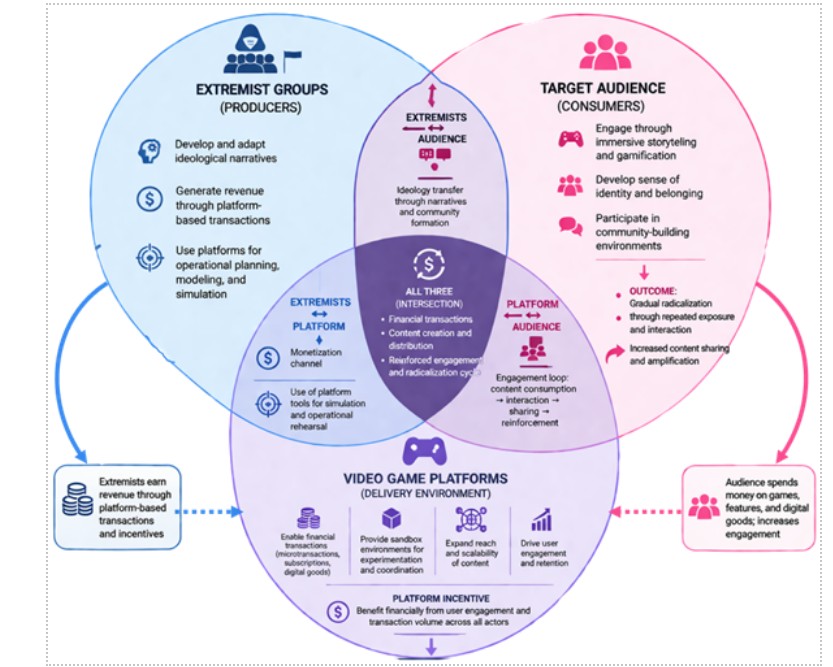
Extremist activity in gaming is often treated as a content problem. It is not. It is a system problem. Gaming platforms operate on a model that connects creators, infrastructure, and users to generate engagement. Extremist groups have adapted this model. What emerges is a platform radicalization system where mechanics that drive growth also drive influence and recruitment.
At the system level, three roles interact:
- Extremists as narrative producers, designing interactive and identity-driven content
- Platforms as amplifiers, scaling narratives through communication and visibility features
- Users as participants, adapting and extending narratives through interaction
This produces a feedback loop where narratives are introduced, engagement amplifies them, and participation normalizes them.
Audiences and Vulnerabilities
Gaming audiences number roughly three billion globally,10 with concentration among ages 11 to 26.11 Persistent environments and multiplayer interaction create conditions where community,12 entertainment, and identity formation occur simultaneously.
Immersive storytelling is the leverage point. Players participate in narratives through avatars and roles, blurring boundaries between fiction and belief, and role-play and self-concept.
Vulnerability exists within the system. Individuals experiencing isolation, identity uncertainty, trauma, or grievance seek belonging in digital spaces.13 Their behaviors align with platform design, including extended time online, high engagement, and responsiveness to emotional narratives.
The overlap between general users and vulnerable individuals allows targeting at scale. Extremist actors do not need to locate vulnerable populations. They identify them through interaction patterns.14 Both groups share similar behaviors and motivations, but differ in how identity becomes anchored. Gaming environments are not uniformly risky. They are selectively exploitable.
Platforms as Infrastructure
Gaming platforms are optimized for engagement through real-time communication, user-generated content, persistent worlds, and algorithmic amplification. These features create continuous feedback loops that deepen user investment.
They also create ideal conditions for influence:
- Low barriers to content creation
- Rapid scaling of narratives
- Seamless movement across platforms
Sandbox environments are especially significant. They allow users to build experiences, turning ideology into interactive systems. Virtual economies introduce financial incentives and pathways.15 The structural tension is clear. Platforms are designed to maximize engagement, while security requires introducing friction.
Extremist Adaptation
Extremist groups operate natively within this system. The virtual economy allows fundraising to support extremist operations. Sandbox environments allow design, planning, and simulation of threat scenario. This approach embeds extremist ideology into gameplay, framing it as missions or scenarios and aligning narratives with identity and grievance.16
Recruitment follows a pattern:
- Identify individuals through behavior
- Introduce ideas gradually, often through humor or ambiguity
- Transition individuals to private or encrypted spaces
Over time, ideology becomes part of lived experience. Success depends on making participation feel natural rather than persuasive.
Functional Shift
The gaming environment itself is repurposed:
- Engagement becomes exposure
- Community becomes targeted belonging
- Identity play becomes alignment
- Content creation becomes ideological production
- Retention becomes network expansion
This creates a durable system where extremists gain reach, platforms maintain engagement, and users gain identity and community. Effective intervention requires shifting focus from content to behavior, from messages to systems, and from removal to disruption.
The Radicalization Pipeline
Radicalization in gaming environments is progressive and behavior-driven, typically unfolding through a pattern of exposure, engagement, migration, and activation. Users are first exposed to ambient narratives embedded in community culture through humor, memes, and language, where norms are established without requiring explicit commitment.17 As engagement deepens, individuals begin to participate, adopt group language, and align with shared perspectives, accelerating identity formation through interaction and social reinforcement. Once alignment takes hold, users often migrate to more controlled environments such as private servers or encrypted platforms, where norms become more rigid and influence intensifies. In the activation phase, ideology is reinforced through repetition and validation, potentially leading to coordination, content creation, or further consolidation. Not all individuals reach this final stage, but those who do have typically undergone sustained identity alignment within these environments.
Indicators and Warning Signs
Risk emerges from patterns over time rather than isolated events.18
Narrative Shifts
- Increasing use of polarized framing
- Adoption of coded language and memes
- Movement toward explicit ideology
Identity Consolidation
- Stronger alignment with group identity
- Reduced openness to alternatives
- Personal experiences framed ideologically
Platform Migration
- Movement to private or invite-only spaces
- Increased use of external communication platforms
Behavioral Intensification
- Increased time in specific communities
- Deepening engagement within small networks
- Repetition of shared narratives
Disruption must target the interaction loop, including how narratives are introduced, how identities align, and how game play reinforces both.
Gaps in Current Response
Current approaches remain misaligned, largely because they prioritize a content-centric model that focuses on removing harmful material while overlooking that radicalization is driven by interaction and lived experience.19 Detection capabilities tend to identify explicit extremism but miss early-stage alignment, where signals are subtle, socially embedded, and behaviorally expressed.20 At the same time, technical systems and psychological insights are often treated separately, creating critical blind spots in understanding how identity and influence evolve within these environments. An effective response requires a shift in posture, moving from content to behavior, from monitoring individual platforms to analyzing cross-platform movement, and from reacting late to detecting early patterns of alignment.
Closing
What emerges for practitioners is a necessary shift in posture. Detection must move beyond keywords to behavioral and narrative patterns, including how language evolves, identities align, and users migrate across spaces. Prevention must invest in pro-social communities and alternative identity pathways that compete with harmful narratives. Intervention must occur early, before movement into closed environments where influence hardens. Platform design should introduce friction in high-risk areas, limiting anonymity abuse and unchecked content creation, while policy must address the full cross-platform ecosystem rather than isolated domains. For homeland security and counterterrorism, this reframes gaming as part of the cognitive battlespace, where the threat lies not only in content, but in identity formation. Advantage will come from understanding narrative, behavior, and environment as an integrated system, because the goal is not simply to remove harmful content, but to disrupt the meaning-making processes that give it power.
Notes
1 Matthew Lawson, “The Impact of Video Games on Social Interaction,” Medium, November 17, 2023, lawsonmatthew.medium.com/the-impact-of-video-games-on-social-interaction-9345c3e7bd23.
2 Wibbu, “The importance of narrative in video games,” Medium, October 10, 2017, https://medium.com/edtech-in-language-learning/the-importance-of-narrative-in-video-games-4a879fb01fe8.
3 Ashish Khaitan, “‘I’m Just Scared’: Teen Hacker Jailed After Massive U.S. School Data Breach,” The Cyber Express, April 16, 2026, https://thecyberexpress.com/hacker-matthew-lane-powerschool-data-breach/.
4 Bride Mallon and Ronan Lynch, “Stimulating Psychological Attachments in Narrative Games: Engaging Players with Game Characters,” Simulation & Gaming 45, no. 4-5 (2014): 508-527.
5 “Marvel Rivals: Global Launch Now,” Marvel Rivals, December 6, 2024, https://www.marvelrivals.com/news/20241205/40185_1198409.html.
6 German Lopez, “Censoring Games,” The New York Times, February 23, 2025, https://www.nytimes.com/2025/02/23/briefing/censoring-games.html.
7 Government of the United Kingdom, Department for Education, “Case Studies,” GOV.UK, Updated September 7, 2023, https://www.gov.uk/government/publications/the-prevent-duty-safeguarding-learners-vulnerable-to-radicalisation/case-studies.
8 Linda Schlegel and Amarnath Amarasingam, “Examining the Intersection Between Gaming and Extremism,” United Nations Office of Counter-Terrorism, October, 2022, https://www.researchgate.net/publication/364196314_Examining_the_Intersection_Between_Gaming_Violent_Extremism.
9 Nevin Ferry, “Radicalization Within Gaming,” (Undergraduate Thesis, York College of Pennsylvania, 2024), 1-18.
10 Menso Hartgers and Eviane Leidig, “Fighting Extremism in Gaming Platforms: A Set of Design Principles to Develop Comprehensive P/CVE Strategies,” ICCT, June 1, 2023, www.icct.nl/publication/fighting-extremism-gaming-platforms-set-design-principles-develop-comprehensive-pcve.
11 “Distribution of video gamers in the United States in 2023, by generation,” Statista, November 27, 2025, https://www.statista.com/statistics/189582/age-of-us-video-game-players/.
12 Jeffrey Gottfried and Olivia Sidoti, “Teens and Video Games Today,” Pew Research Center, Pew Research Center, May 9, 2024, https://www.pewresearch.org/internet/2024/05/09/teens-and-video-games-today/.
13 Anat Shoshani, Shahar Braverman, and Galya Meirow, “Video games and close relations: Attachment and empathy as predictors of children’s and adolescents’ video game social play and socio-emotional functioning,” Computers in Human behavior 114 (2021): 106578.
14 Soumya Awasthi, “Gaming platforms: A new frontier for extremist recruitment and radicalization,” Observer Research Foundation, December 5, 2024, https://www.orfonline.org/expert-speak/gaming-platforms-a-new-frontier-for-extremist-recruitment-and-radicalisation.
15 “Sandbox Economy Overview,” Emergent Mind, Updated September 15, 2025, https://www.emergentmind.com/topics/sandbox-economy.
16 Ferry, “Radicalization Within Gaming,” 6.
17 Hartgers and Leidig, “Fighting Extremism in Gaming Platforms.”
18 Kaitlin Tiches, “Children’s Views on Gaming,” Boston Children’s Digital Wellness Lab, September, 2023, https://digitalwellnesslab.org/research-briefs/childrens-views-on-gaming/.
19 Agus Raharjo, Dwi Hapsari Retnaningrum, Esmara Sugeng, Yusuf Saefudin, and Noorfajri Ismail, “Radicalization and Counter-Radicalization on the Internet (Roles and Responsibilities of Stakeholders in Countering Cyber Terrorism),” E3S Web of Conferences 609, (2025): 7003.
20 Hartgers and Leidig, “Fighting Extremism in Gaming Platforms.”
Bibliography
Awasthi, Soumya. “Gaming platforms: A new frontier for extremist recruitment and radicalization.” Observer Research Foundation, December 5, 2024. https://www.orfonline.org/expert-speak/gaming-platforms-a-new-frontier-for-extremist-recruitment-and-radicalisation.
“Distribution of video gamers in the United States in 2023, by generation.” Statista, November 27, 2025. https://www.statista.com/statistics/189582/age-of-us-video-game-players/.
Ferry, Nevin. “Radicalization Within Gaming.” (Undergraduate Thesis, York College of Pennsylvania, 2024), 1-18.
Gottfried, Jeffrey and Olivia Sidoti. “Teens and Video Games Today.” Pew Research Center, May 9, 2024. https://www.pewresearch.org/internet/2024/05/09/teens-and-video-games-today/.
Government of the United Kingdom, Department for Education, “Case Studies,” GOV.UK, Updated September 7, 2023, https://www.gov.uk/government/publications/the-prevent-duty-safeguarding-learners-vulnerable-to-radicalisation/case-studies.
Hartgers, Menso and Eviane Leidig. “Fighting Extremism in Gaming Platforms: A Set of Design Principles to Develop Comprehensive P/CVE Strategies.” ICCT, June 1, 2023, www.icct.nl/publication/fighting-extremism-gaming-platforms-set-design-principles-develop-comprehensive-pcve.
Khaitan, Ashish. “‘I’m Just Scared’: Teen Hacker Jailed After Massive U.S. School Data Breach.” The Cyber Express, April 16, 2026. https://thecyberexpress.com/hacker-matthew-lane-powerschool-data-breach/.
Lawson, Matthew. “The Impact of Video Games on Social Interaction.” Medium, November 17, 2023. lawsonmatthew.medium.com/the-impact-of-video-games-on-social-interaction-9345c3e7bd23.
Lopez, German. “Censoring Games.” The New York Times, February 23, 2025. https://www.nytimes.com/2025/02/23/briefing/censoring-games.html.
Mallon, Bride and Ronan Lynch. “Stimulating Psychological Attachments in Narrative Games: Engaging Players with Game Characters.” Simulation & Gaming 45, no. 4-5 (2014): 508-527.
“Marvel Rivals: Global Launch Now,” Marvel Rivals, December 6, 2024, https://www.marvelrivals.com/news/20241205/40185_1198409.html.
Raharjo, Agus, Dwi Hapsari Retnaningrum, Esmara Sugeng, Yusuf Saefudin, and Noorfajri Ismail. “Radicalization and Counter-Radicalization on the Internet (Roles and Responsibilities of Stakeholders in Countering Cyber Terrorism).” E3S Web of Conferences 609, (2025): 7003.
“Sandbox Economy Overview.” Emergent Mind, Updated September 15, 2025. https://www.emergentmind.com/topics/sandbox-economy.
Schlegel, Linda and Amarnath Amarasingam. “Examining the Intersection Between Gaming and Extremism.” United Nations Office of Counter-Terrorism, October, 2022. https://www.researchgate.net/publication/364196314_Examining_the_Intersection_Between_Gaming_Violent_Extremism.
Shoshani, Anat, Shahar Braverman, and Galya Meirow. “Video games and close relations: Attachment and empathy as predictors of children’s and adolescents’ video game social play and socio-emotional functioning.” Computers in Human behavior 114 (2021): 106578.
Tiches, Kaitlin. “Children’s Views on Gaming.” Boston Children’s Digital Wellness Lab, September, 2023. https://digitalwellnesslab.org/research-briefs/childrens-views-on-gaming/.
Wibbu. “The importance of narrative in video games.” Medium, October 10, 2017. https://medium.com/edtech-in-language-learning/the-importance-of-narrative-in-video-games-4a879fb01fe8.