

On June 1, 2026, the Middle East Media Research Institute’s Jihad and Terrorism Threat Monitor (JTTM) published a report about a pro-ISIS media outlet poster highlighting Pope Leo XIV’s scheduled visit to Spain during the FIFA World Cup, implying imminent disaster.
This report follows an earlier report from the JTTM project about threats to this year’s World Cup from radicalized lone wolves and Iran’s “cyber resistance” proxies.
On June 1, 2026, a pro–Islamic State (ISIS) media outlet released a propaganda poster condemning Pope Leo XIV’s apostolic visit to Spain, scheduled for June 6–12, 2026.
The poster, attributed to Al‑Iman Media Center, depicts a decaying, zombie-like pope figure, holding a FIFA-branded soccer ball. The timing of the release appears deliberate, coinciding with the opening of the 2026 FIFA World Cup on June 11.
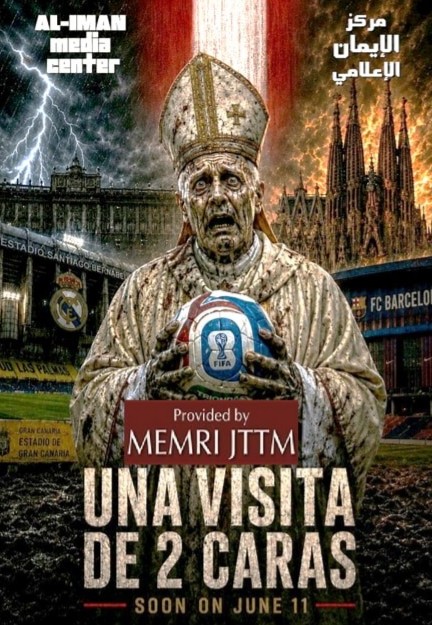
The composition is split into two contrasting scenes. On the left, Madrid’s Santiago Bernabéu Stadium is shown under dark storm clouds with lightning striking overhead. On the right, Barcelona’s Sagrada Família Basilica is portrayed engulfed in flames beneath an apocalyptic sky, with the FC Barcelona crest visible.
The main Spanish text reads “UNA VISITA DE 2 CARAS” (A Two-Faced Visit), accompanied by the phrase “SOON ON JUNE 11” at the bottom of the poster.
The imagery and messaging directly reference key events in the Pope’s itinerary, including his June 8 meeting with the diocesan community at Santiago Bernabéu Stadium, the June 10 Holy Mass and inauguration of the Tower of Jesus Christ at the Sagrada Família, and the June 11 travel from Barcelona to Gran Canaria, where he is scheduled to meet migrant organizations and celebrate Mass at Gran Canaria Stadium.
Overall, the poster frames the visit as hypocritical by blending religious symbolism with football imagery, portraying the trip as “two-faced” and accusing the Catholic Church and Western institutions of duplicity.