
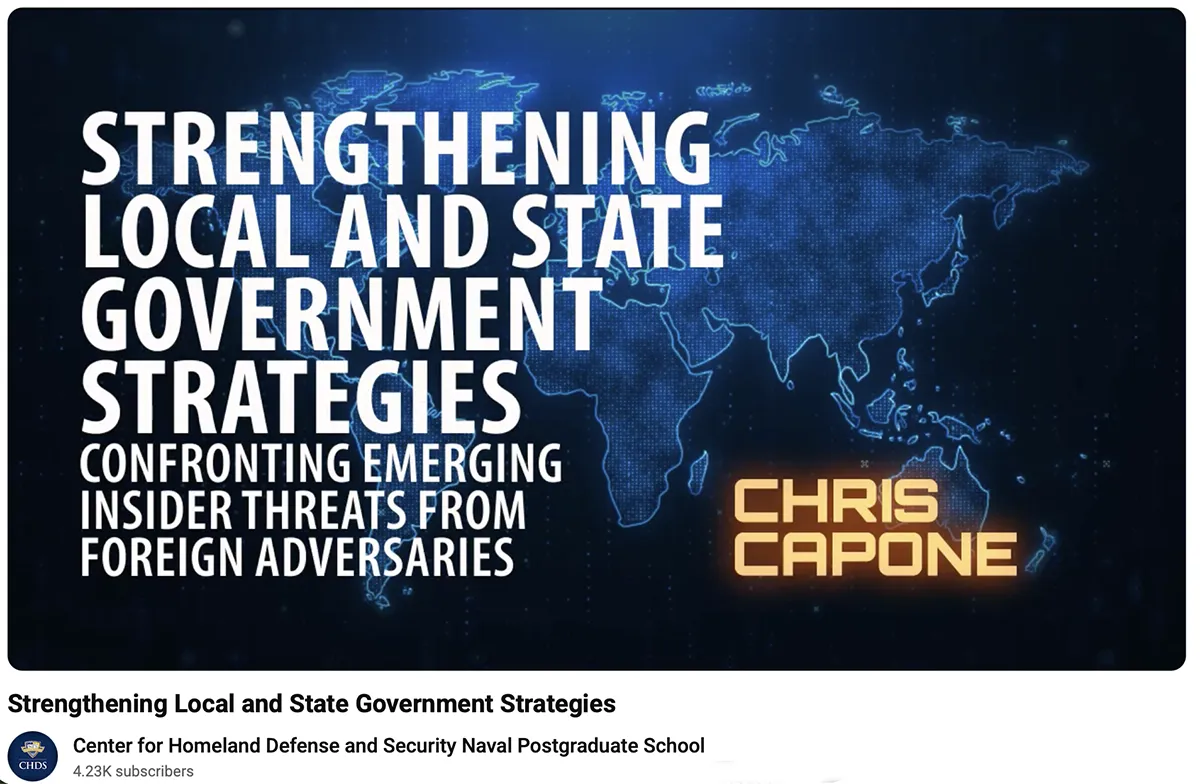
A research thesis by New York Police Detective (NYPD) Detective Chris Capone argues that foreign governments are increasingly targeting state and local agencies in the United States, and that most of those agencies are not prepared to recognize or respond to the threat.
The research, conducted through interviews with NYPD leadership and presented through the Naval Postgraduate School’s Center for Homeland Defense and Security (CHDS), contends that while federal agencies have well-established programs to address insider threats and foreign influence, state and local governments largely do not.
A Shift in Focus, According to the Research
Capone’s thesis, “Strengthening Local and State Government Strategies: Confronting Emerging Insider Threats From Foreign Adversaries,” distinguishes between two types of foreign activity. Transnational repression, he says, typically involves foreign governments monitoring or pressuring members of their own diaspora communities living in the United States. Foreign malign influence operations, by contrast, are described as targeting local and state officials, their staff and advisers, and others who have access to sensitive but often unclassified information, covering topics such as public safety, infrastructure, elections, and local technology systems.
According to the research, this unclassified information is frequently undervalued, even though it can be exploited to turn an individual into what Capone calls an “insider threat” (sometimes without that person being aware of it).
The thesis describes differing approaches among adversary nations:
- China is characterized as employing a long-term strategy that involves building relationships and cultivating influence over extended periods.
- Russia is described as exploiting existing social or political divisions, sometimes using local actors – wittingly or unwittingly – to shape narratives or affect local elections.
- Iran is said to focus on dissident communities, with the thesis noting that resulting cases can be mistaken by local police for routine harassment if officers are not aware of the broader pattern.
“Soft Underbelly” Designation
The thesis notes that federal officials have, in recent years, referred to state and local agencies as the “soft underbelly” of national security, citing their access to sensitive information and their proximity to decision-makers. It also references comments made by then-Secretary of State Mike Pompeo in 2020, who called on state and local leaders to better understand how foreign governments operate within their communities.
Based on interviews conducted with NYPD intelligence leadership, Capone’s research found that few local agencies currently maintain insider threat programs or related training, and concludes that the central issue is a lack of awareness rather than a lack of resources.
Four Recommendations
The thesis outlines four recommendations for state and local agencies:
- Insider threat training for all employees, designed to help staff identify, question, and report suspicious behavior, while addressing workplace cultures that may discourage internal reporting or whistleblowing.
- Strategic messaging and intergovernmental coordination, to help public servants understand that their access to information may be of value to foreign intelligence services, and to counter the perception that insider threats are solely a federal concern.
- Improved coordination between government agencies, including the development of protocols for sharing threat-related information at an unclassified level, since many state and local employees do not hold security clearances.
- Tailored messaging strategies, calibrated to convey urgency without discouraging engagement or creating undue alarm among employees.
Capone’s thesis argues that – with greater awareness, training, and information-sharing – state and local agencies can become more active partners in national security efforts rather than remaining, in his words, “soft targets.” The research frames federal-local partnership as essential, noting that federal agencies alone cannot address threats that increasingly intersect with local government operations.
For the full “Strengthening Local and State Government Strategies: Confronting Emerging Insider Threats From Foreign Adversaries” thesis, visit the CHDS Homeland Security Digital Library at https://www.hsdl.org/c/abstract/?docid=900823.