
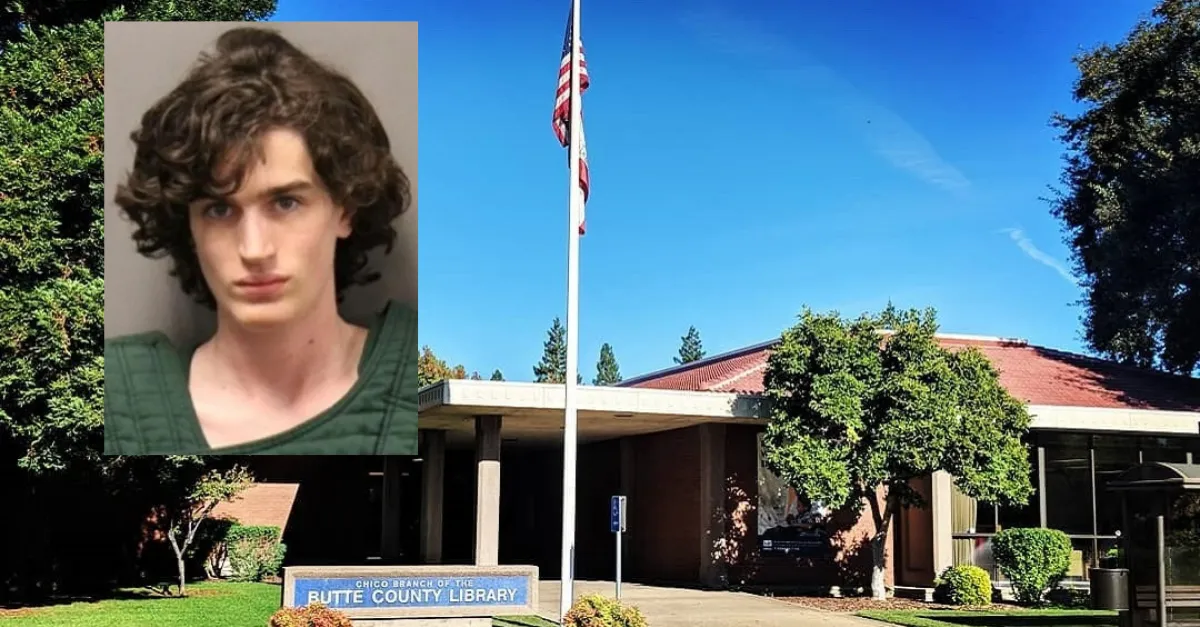
The 18-year-old accused of opening fire and killing two people at a Northern California library on June 22 was obsessed with mass shootings and intended to kill as many people as possible, according to Butte County District Attorney Mike Ramsey. Had he known how to properly operate the shotgun he used at the Butte County Library’s Chico branch, said Ramsey, he likely would have caused many more casualties.
The suspect, Bradley Scott Sayer, appeared in Butte County Superior Court Thursday, June 25, for arraignment, where he was ordered held without bail on two counts of first-degree murder, plus firearm-use and multiple-murder special circumstance enhancements. He did not enter a plea and the case was continued to July 16. Ramsey said prosecutors will not seek the death penalty and will instead pursue life in prison without parole. Defense attorney Roberto Marquez has been retained to represent Sayer.

While entering and exiting the hearing, Sayer was captured making a hand gesture associated with white supremacist groups. This same hand gesture was seen flashed by the Christchurch, New Zealand, shooter Brenton Tarrant in court, after killing 51 people in 2019, and similar gestures have been seen demonstrated by members of the Proud Boys.
A Years-Long Obsession with Columbine
According to Ramsey, investigators believe Sayer’s path toward the attack began roughly four years ago, when he became immersed in online communities glorifying mass shootings, particularly the 1999 Columbine High School massacre. Sayer kept a journal, recovered by investigators, that documents this fixation and references Columbine and other mass shootings over a multi-year period. Behavioral health experts are now reviewing the journal alongside prosecutors to better understand Sayer’s mindset leading up to the attack.
On the day of the attack, authorities say Sayer dressed in black clothing with suspenders and a white T-shirt bearing the handwritten phrase “Natural Selection,” similar to the one worn by one of the Columbine shooters. Less than 30 minutes before the attack, Sayer is alleged to have recorded and uploaded a video of himself in the outfit to social media sites dedicated to mass-shooting discussions, stating his intent to go to the library and kill as many people as he could.
Federal authorities are pursuing search warrants for the online platforms Sayer used, and the Federal Bureau of Investigation (FBI) has been working alongside the Chico Police Department and the Butte County Sheriff’s Office throughout the investigation.
Access to Firearms and the Question of Parental Accountability
Sayer had been staying at his father’s home while his father was out of town. Investigators say he retrieved three firearms from a closet in his father’s bedroom – two .22-caliber rifles and a 20-gauge pump-action shotgun – along with boxes of birdshot ammunition. Ramsey said the father owned a gun safe, though it remains unclear whether the weapons were secured in it at the time.
The circumstances echo a growing legal trend of prosecuting parents over their children’s shootings. James and Jennifer Crumbley were convicted of involuntary manslaughter in April 2024 after their son killed four students at Michigan’s Oxford High School in 2021; prosecutors said the couple bought him a gun days earlier and ignored signs of his deteriorating mental health, including a violent drawing shown to them hours before the attack. Both were sentenced to 10 to 15 years.
In Georgia, a jury convicted Colin Gray of 27 charges, including two counts each of second-degree murder and involuntary manslaughter, in March 2026 after his 14-year-old son allegedly killed two students and two teachers at Apalachee High School in 2024; prosecutors said Gray gave his son an AR-15-style rifle despite an FBI warning about prior threats. Gray faces up to 180 years and is set to be sentenced July 28–29. A similar case is pending in Wisconsin against Jeffrey Rupnow, charged after his daughter killed a student and teacher before killing herself in 2024. She retrieved one from his gun safe as she knew the code and another may have been left out after it was cleaned the day before the shooting.
It is not known whether Butte County prosecutors are considering charges against Sayer’s father.
The Attack
Sayer drove to the library, parked, and initially walked inside without a weapon, according to Ramsey. He then returned to his vehicle, retrieved the shotgun, and headed back toward the building.
Outside the library, Sayer encountered Jacob “Cody” Hull, 46, a maintenance supervisor at a local hotel who had brought his 7-year-old niece to pick out books. Prosecutors allege Sayer shot Hull in the leg before shooting him again at close range in the head, killing him. The girl, witnessing the attack, fled into the library through a shattered window, suffering cuts to her abdomen that were not considered life-threatening. She was treated and later released from the hospital.
Once inside, Ramsey said Sayer fired randomly at patrons – including children – as people tried to escape. Library staff managed to move roughly half of the approximately 20 people inside into a back room, locking the door behind them.
Sayer is accused of then encountering Robert Johnson, 77, a retired farm manager seated at a table reading. Prosecutors say Sayer shot Johnson twice in the head: once as he sat, and again after he had fallen.
Autopsies confirmed both Hull and Johnson died of shotgun wounds, according to the Butte County Sheriff’s Office.
A Critical Detail: An Unfamiliar Weapon
Ramsey said evidence indicates Sayer had never fired the shotgun before the attack and didn’t know how to load its magazine tube, a key factor prosecutors believe limited the scope of the violence. Although the Remington pump-action shotgun could hold six rounds, investigators say Sayer loaded and fired it one shell at a time, pulling individual rounds from his pocket between shots rather than fully loading the weapon.
“It was a very slow process, as opposed to just shooting rapidly with the pump-action, and so it could’ve been much, much worse,” Ramsey said. Authorities believe Sayer fired approximately eight rounds total during the attack.
Attempted Arson, Then Surrender
As Chico Police surrounded the building, officers observed Sayer striking kitchen matches in an apparent attempt to set the library on fire, possibly to delay first responders from reaching victims, according to Ramsey. When that failed, Sayer reportedly tried loading a rifle round into the shotgun in an apparent attempt to take his own life; the round did not fit and fell through the barrel.
Officers ultimately got Sayer’s attention from outside the building, and he surrendered without further incident. He is currently being held on suicide watch at the Butte County Jail.
The Investigation Continues
Police say Sayer acted alone, and investigators have found no prior relationship between Sayer and any of the victims. No library employees or law enforcement personnel were injured during the incident.
Chico Police Chief Billy Aldridge said a search of Sayer’s vehicle in the library parking lot turned up two additional firearms registered to family members; investigators are still working to determine how Sayer gained access to them. Ramsey also noted that no security personnel were stationed inside the library at the time of the shooting, though the county contracts with a private security firm that patrols library parking lots and exterior grounds.
Sayer Represents a Pattern of Behavior
Sayer’s case follows a pattern federal authorities have documented elsewhere: years-long immersion in online “fan” subcultures built around past shooters. One framework used to intervene before such radicalization turns violent is behavioral threat assessment and management (BTAM), described by the Department of Homeland Security (DHS) as a systematic, fact-based process designed to help safety stakeholders identify threats and prevent acts of targeted violence, which DHS stresses is not profiling, predictive, or punitive in nature. DHS’s Center for Prevention Programs and Partnerships (CP3) uses multidisciplinary teams – drawing on education, mental health, social services, law enforcement, and faith communities – to flag concerning behavior early and coordinate intervention before it escalates. It is not known whether Sayer was previously flagged by any such process.