
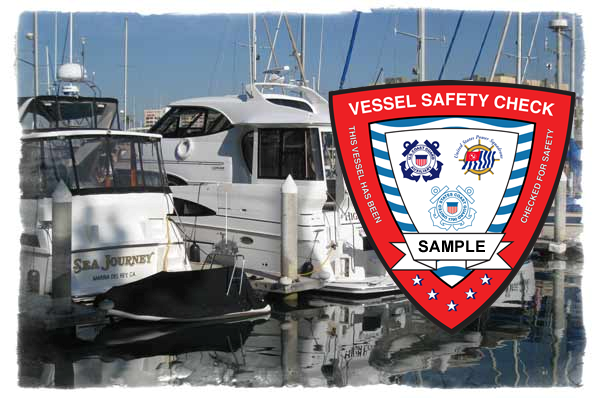
On lakes, rivers, bays, inland reservoirs, and coastal waters across America, boating is one of the country’s most popular ways to spend time outdoors. It is also one of the easiest places for a small mistake to become a serious emergency. A missing life jacket, a dead battery, a fire extinguisher that will not work, or a boat that has not been checked in months can turn an ordinary outing into a dangerous situation in seconds.
That is why every boater should seek a free Vessel Safety Check from a U.S. Coast Guard Auxiliary vessel examiner before heading out. The check is free, it is designed to help rather than punish, and it usually takes only 15 to 30 minutes, depending on the size of the boat. For such a small investment of time, boaters gain peace of mind, better readiness, and one more layer of protection for everyone on board.
A small step with large consequences
Boaters often pay close attention to fuel, fishing gear, electronics, or appearance, but safety gear can be easy to overlook. That is the danger. The most important items on a vessel are often the ones that sit unused until the day they are needed most. A free Vessel Safety Check gives owners a chance to confirm that life jackets, navigation lights, fire extinguishers, distress signals, registration markings, and other required items are in place and working as they should.
The value of this process is not theoretical. The U.S. Coast Guard reported 3,887 recreational boating incidents nationwide in 2024, with 556 fatalities, 2,170 injuries, and about $88 million in property damage. Those numbers show that boating remains a serious safety issue even in a year that saw the fewest fatalities in more than 50 years of recordkeeping. In other words, progress has been made, but the risk is still real.
What the numbers are telling us
The strongest message in the national data is that many tragedies are preventable. Alcohol remained the leading known contributing factor in fatal boating accidents in 2024, accounting for 92 deaths, or 20 percent of total fatalities. Drowning was the leading cause of death, and most drowning victims were not wearing life jackets. Operator inattention, improper lookout, operator inexperience, machinery failure, and navigation rules were among the top contributing factors in accidents.
That pattern matters because it points to hazards that a Vessel Safety Check can help expose before launch. A VSC will not eliminate every human error on the water, but it can ensure the vessel itself is not adding to the danger. If the boat is compliant and the equipment is ready, the operator has a better chance of handling a problem before it becomes a tragedy.
Why the free check matters nationwide
The U.S. Coast Guard Auxiliary offers Vessel Safety Checks across the country, and the process is intentionally simple. A vessel examiner can meet the owner at a dock, ramp, marina, or other convenient location, and the check usually takes 15 to 30 minutes. If the vessel does not pass, no citation is issued during the inspection; instead, the boater receives guidance on what needs to be corrected.
That makes the program especially useful for new boat owners, seasonal operators, and anyone who has not reviewed their safety equipment recently. It also helps experienced boaters avoid the false confidence that comes from assuming a vessel is ready because it has not had a problem yet. The free VSC is not about embarrassment or enforcement. It is about readiness, responsibility, and prevention.
What a vessel examiner looks for
A Vessel Safety Check is not a casual glance. It is a practical inspection of the items that matter most in an emergency. Examiners review flotation devices, fire extinguishers, navigation lights, registration compliance, sound-producing devices, distress signals, and other required equipment. These are the basics that determine whether a boat can handle a routine day on the water or respond to an unexpected problem.
A lot of serious issues are invisible from shore. Fire extinguishers may be recalled or expired. Life jackets may be the wrong size or missing. Flares may be outdated. Lights may fail. Batteries may be weak. The check catches those problems early, before the boat is already underway and the options are limited.
Why this matters to every region
This issue is not limited to a single state, a single coastline, or a single type of water. A family on a Great Lakes cruiser, a fishing crew on a western reservoir, a weekend boater on a southern river, and a kayak group on an inland lake all face the same basic truth: the water is unforgiving when preparation is weak. That is why compliance must be treated as a national boating habit, not a seasonal extra.
The same small lapses occur in accident reports across the country. One boater skips a life jacket because the trip feels short. Another assumes a fire extinguisher still works. Other leaves have incomplete registration or worn-out gear. These decisions are minor in the moment, but they can have major consequences when conditions change.
The case for making it routine
The best boating safety habits are the ones that become routine. Just as boaters check fuel, weather, and trailer connections before a trip, they should also check that the vessel is ready for the conditions ahead. A free Vessel Safety Check is one of the easiest ways to strengthen that routine.
The check costs nothing, takes little time, and can reveal issues that may otherwise go unnoticed until an emergency. It also gives the boater a chance to ask questions and learn more about safe operation from someone trained to look for common problems. That is a benefit not just to the owner but to everyone who shares the water.
A national call to action
Recreational boating should be enjoyable, but it should also be responsible. The national statistics make clear that accidents, injuries, and deaths are still happening at an unacceptable rate, and many of them involve preventable conditions. A free Vessel Safety Check is one of the simplest ways for boaters to take ownership of their safety before a problem starts.
Before the next launch, make sure the vessel is compliant, the safety gear is up to date, and the equipment will work when needed. Then schedule a free check with a U.S. Coast Guard Auxiliary vessel examiner. It is a small step that can protect lives, reduce accidents, and strengthen boating safety nationwide.
Disclaimer: This article is provided for general informational purposes only and is not legal advice, boating enforcement advice, or a substitute for current federal, state, or local boating safety requirements. Boaters should confirm equipment and operating requirements with the U.S. Coast Guard, the U.S. Coast Guard Auxiliary, and their applicable state boating authority before operating a vessel. The views expressed in this article are solely those of the author and do not represent the official views of the United States Coast Guard, the United States Coast Guard Auxiliary, the Department of Homeland Security, or any government agency.
References
U.S. Coast Guard Auxiliary. (n.d.). Vessel safety checks. https://cgaux.org/vsc/
U.S. Coast Guard Auxiliary. (n.d.). Vessel safety checks. https://www.uscgauxsoportlandme.com/ppages/pvsc/vscabout.html
U.S. Coast Guard. (2025, June 30). Coast Guard reports fewest boating fatalities in more than 50 years. https://www.news.uscg.mil/Press-Releases/Article/4231745/coast-guard-reports-fewest-boating-fatalities-in-more-than-50-years/
Safe Boating Council. (n.d.). Recreational boating facts. https://www.safeboatingcouncil.org/resources/recreational-boating-facts/
U.S. Coast Guard Boating Safety Division. (n.d.). Accident statistics. https://uscgboating.org/statistics/accident_statistics.php
U.S. Coast Guard. (2025, May 27). Coast Guard releases 2023 recreational boating statistics. https://www.news.uscg.mil/Press-Releases/Article/3788966/coast-guard-releases-2023-recreational-boating-statistics/