
Key Takeaways
- ICE has increased its enforcement efforts and expanded detention capacity since January 2025.
- The Army and ICE opened ICE’s largest facility—Camp East Montana—quickly, which led to several issues. The contract requires ICE to pay the full cost of meals and operational services for 5,000 people, even when the facility’s population is far lower. For example, the facility held about 1,600 detained non-citizens at the end of February 2026. This resulted in millions of dollars of waste.
- The facility also did not meet key detention standards, risking the safety and security of detained noncitizens and staff.
- The GAO’s recommendations address these issues.
What GAO Found
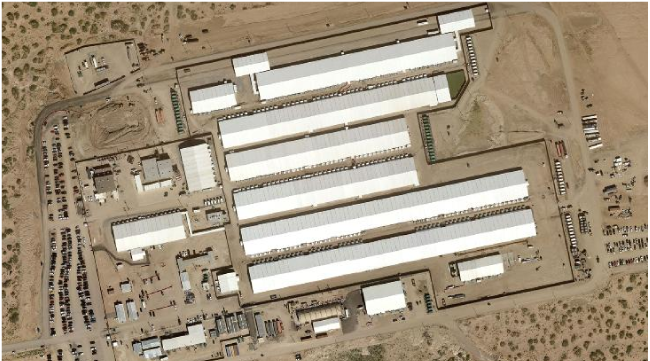
In August 2025, U.S. Immigration and Customs Enforcement (ICE)’s largest immigration detention facility to date (known as Camp East Montana) opened on U.S. Army Fort Bliss in El Paso, Texas. GAO found that the Army—which awarded and administered the $1.3 billion facility contract—and ICE expedited the award and construction schedule for the facility. This negatively affected their planning and acquisition. Army and ICE officials indicated that the expedited time frames directed by senior leadership dictated several decisions related to their acquisition approach, such as using a contracting vehicle not previously used for detention services. They also selected a contractor that did not have prior experience providing detention services. The Army transferred contract administration responsibilities to ICE in October 2025.
GAO found that the Army did not incorporate flexibilities in the contract to account for occupancy levels below the maximum, resulting in millions of dollars in waste. For example, the Army paid the full cost for meals and services from August 1 to August 15, 2025, when there were no detained noncitizens at the facility. GAO also found that ICE could save tens of millions of dollars through September 2026 by incorporating cost saving measures in the contract, such as tiered pricing for meals. In April 2026, ICE terminated the contract for convenience and chose a new contractor to operate the facility. However, ICE had not yet incorporated these cost saving measures into the new contract and continued to pay for meals that it did not need.
GAO also identified serious performance and oversight challenges at Camp East Montana. The facility opened without meeting key detention standards. For example, the facility initially did not have perimeter security cameras, outdoor recreation space, or space for attorney and family visitation. ICE did not identify these issues because it did not inspect the facility prior to housing detained noncitizens there, as required by ICE policy. After the facility opened, ICE reported additional problems, including gaps in medical services, the loss of a loaded firearm, and unsanitary conditions, among other issues. These issues posed serious risks to the safety and security of both detained noncitizens and staff in the facility.
Why GAO Did This Study
ICE increased its enforcement efforts and expanded its detention capacity in response to a January 2025 Executive Order. ICE’s average daily population of detained noncitizens increased 71 percent from January 20, 2025 to April 1, 2026, according to ICE data.
This report from the GAO provides observations from our ongoing review of ICE’s expansion of immigration detention operations and focuses on (1) how the Army and ICE planned for and acquired Camp East Montana and (2) oversight of the facility. We are issuing this report given the need for ICE to take immediate corrective actions to save taxpayer dollars and improve detention operations.
To conduct this audit, GAO visited Camp East Montana and observed facility operations in September 2025. GAO reviewed relevant statutes and regulations, agency policies, contract documentation, and Army and ICE reports on Camp East Montana operations. GAO also analyzed facility population data and invoices to calculate waste and potential cost savings. GAO interviewed Army and ICE officials and contractors to discuss operations and oversight.
Recommendations
GAO is making four recommendations, including that ICE incorporate cost saving measures in detention facility contracts, such as tiered pricing for food and other services to account for fluctuations in population; and that ICE develop controls to ensure that new facilities are inspected as required and meet applicable detention standards prior to housing detained noncitizens. DHS and DOD concurred with the recommendations.