
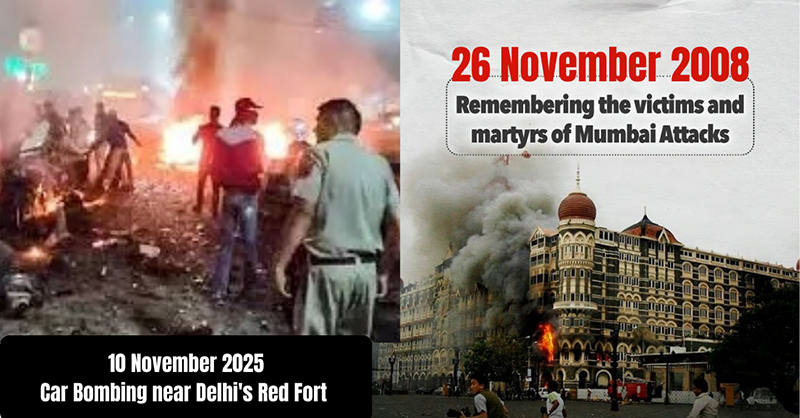
Seventeen years after the devastating Mumbai attacks, a deadly car bombing near Delhi’s Red Fort on November 10, 2025, has exposed a chilling evolution in terrorist operations, one that trades street fighters for university-educated professionals.
The suicide bombing, which has claimed 15 lives so far and injured 32 others, initially appeared to be an isolated incident. But investigations have since revealed a sprawling conspiracy involving highly educated medical professionals, sophisticated weapons procurement networks, and direct links to Pakistan-based terror groups: a blueprint disturbingly reminiscent of the Mumbai attacks in 2008 that killed 166 people and injured around 300 people.
Two Years of Planning: A Familiar Timeline
The parallels between the two attacks are striking, beginning with their extended planning phases. The 2008 Mumbai assault, which began on November 26 and ended November 29, was meticulously orchestrated over more than two years by Lashkar-e-Taiba (LeT) working with Pakistan’s Inter-Services Intelligence (ISI). Pakistani-American terrorist David Coleman Headley (born Dawood Sayed Gilani) made five reconnaissance trips to Mumbai between September 2006 and July 2008, posing as a businessman while systematically surveying targets including the Taj Mahal Hotel, Oberoi Hotel, and Chabad House.
Similarly, Dr. Muzammil Shakeel has confessed to investigators that the Delhi conspiracy began in 2023: a two-year planning cycle that mirrors Mumbai’s timeline. Over those two years, this network of educated professionals accumulated over 5700 pounds of NPK (nitrogen (N), phosphorus (P), and potassium (K)) fertilizer, purchased Russian-origin assault rifles, began prepping dozens of cars to carry explosive materials (like the Hyundai i20 car used in the bombing), and established encrypted communication channels with handlers operating from Pakistan and Türkiye.
The Professional Face of Terror
The bomber, Dr. Umar Mohammad (also known as Umar-un-Nabi), represents a disturbing shift in terrorist recruitment. Not a desperate recruit from a conflict zone but a medical professional who extensively studied bomb-making tutorials, manuals, and open-source material online under guidance from handlers based in Türkiye.
An undated video surfaced after his death and is thought to be several months old, having been recorded on the premises of Al-Falah University.

It features Umar seeming to rehearse a statement justifying suicide bombing as what he called “martyrdom” operations. His technical approach was methodical: He sourced chemical ingredients from Nuh (in the state of Haryana within the National Capital Region of India), electronic components from Delhi’s Bhagirath Palace (one of Asia’s largest wholesale electrical and electronic markets) as well as Faridabad’s NIT Market, and used a deep freezer to stabilize and process the explosive mixture.
The National Investigation Agency (NIA), India’s principal counterterrorism law enforcement agency, has uncovered what officials describe as a “white collar terror ecosystem” involving radicalized professionals using encrypted channels for coordination. Four main suspects are in NIA custody: Dr. Muzammil Shakeel Ganai of Pulwama, Dr. Adeel Ahmed Rather of Anantnag, Dr. Shaheen Saeed of Lucknow, and Mufti Irfan Ahmad Wagay of Shopian. Adeel’s brother, Dr. Muzaffar Ahmed Rather, has reportedly fled the country to Afghanistan. The doctors’ radicalization allegedly began when they were pursuing the Bachelor of Medicine and Bachelor of Surgery (MBBS) course, and their handlers began working on them as far back as 2020.
A New Model Terrorism: Self-Funded
The financial independence of this network marks another evolution in terrorist operations. The group raised Rs 26 lakh (~$29,010 USD) entirely through self-funding, with members contributing amounts ranging from approximately $2230 to $8926. Dr. Umar, the suicide bomber, contributed Rs 2 lakh or ~$2230.
This financial autonomy makes detection significantly more challenging than tracking funds flowing from established terror organizations. This may be a lesson learned from Mumbai, where LeT’s ISI-backed funding left traceable footprints from bank transactions, communication chains, an earlier $2M fraud investigation, and other digital footprints.
Tensions within the group nearly derailed the plot when a financial dispute erupted between Umar and Muzammil at Al-Falah University, witnessed by several students. Following the clash, Umar reportedly handed his red EcoSport – already loaded with explosive material – to Muzammil, suggesting the November 10 detonation may have been unplanned, a “panic detonation” that prevented an even larger coordinated attack.
Pakistan’s Persistent Shadow
While Indian media has reported links to Pakistani militant groups, Prime Minister Narendra Modi’s administration has exercised notable restraint in its public response. According to political analysts, this measured approach reflects recognition that there is little international appetite for another military exchange with Pakistan, despite India’s May 2025 announcement of a new military doctrine that “eliminated the false distinction between terrorists and their state sponsors.”
Yet the operational fingerprints point unmistakably toward Pakistan. Investigators have linked the Delhi conspiracy to Jaish-e-Mohammed (JeM) and Ansar Ghazwat-ul-Hind, an al-Qaeda-affiliated terror group, with handlers named Mansoor, Hashim, and Ibrahim directing operations. Dr. Muzammil, Adil, and Muzaffar traveled to Türkiye with plans to enter Afghanistan under instructions from an operative known as Okasa, who is associated with Tehrik-e-Taliban Pakistan (TTP).
The recovery of Russian-origin assault rifles, including an AK-47 purchased for more than $7250 USD and an AK Krinkov, alongside nearly 2,900 kg (approximately 6393 lbs) of explosive materials (ammonium nitrate), points to procurement networks requiring sophisticated international coordination, logistics eerily similar to those that armed the Mumbai attackers.
The 2008 Mumbai attacks exposed direct ISI involvement through the testimony of Ajmal Kasab, the sole surviving attacker executed in 2012, and confessions from David Headley and Tahawwur Rana in American courts. Today’s investigation suggests similar state-level support structures remain operational, merely adapted for a new generation of educated, self-funded operatives.
The Intelligence Gap Persists
Despite multiple intelligence agencies operating in Delhi – including Delhi Police, the Intelligence Bureau, and the NIA – gaps in coordination allowed this network to operate undetected for two years in the national capital region, assembling massive quantities of explosives and military-grade weapons within striking distance of India’s seat of power.
This represents an intelligence failure hauntingly similar to 2008. Before the Mumbai attacks, multiple warnings had been missed or ignored. The comprehensive reconnaissance conducted by Headley – including GPS marking of landing sites and surveillance videos of targets – should have triggered alerts. Yet the attackers landed by sea and executed their assault with devastating precision.
Symbolic Targeting: Psychological Warfare
Both attacks demonstrate sophisticated understanding of psychological impact. In 2008, LeT deliberately targeted Mumbai’s most iconic locations: luxury hotels frequented by foreigners, a major railway station, and a Jewish community center. The message was calculated: strike at symbols of India’s cosmopolitan modernity and international connections.
The choice of Delhi’s Red Fort area carries similar symbolic weight. The Red Fort, synonymous with Indian sovereignty and the site of Independence Day celebrations, represents far more than its physical location. According to retired Lieutenant General Shokin Chauhan, Indian Army veteran soldier and former commander of the 11 Gorkha Rifles, states in his Substack, it was “timed with deliberate precision for maximum psychological shock … It is part of a continuing arc of threats that have evolved, multiplied, and adapted since the first organised terrorist strikes on Indian soil.”
Terrorists rarely strike for spectacle alone, Chauhan notes. “They strike when they want to pressure the political system, when they need to reassert relevance, or when their external handlers want to shift public attention. This attack feels like part of that larger psychological game.” The Delhi blast, like Mumbai before it, succeeds on those terms even if the larger plot was disrupted.
Dr. Ajit Maan – Founder and CEO of Narrative Strategies, author of the seminal Counter-Terrorism: Narrative Strategies, and Editor at Large for Homeland Security Today’s Counter-Narrative vertical – importantly points out that, “The Delhi attack should draw our attention to the way recruitment is happening, whether highly trained professionals or children, civilians are radicalized with stories rather than guns to the head – psychological manipulation rather than physical force.”
Lessons from Mumbai, Still Unlearned
The investigation continues to reveal a conspiracy planning simultaneous attacks across multiple Indian cities, making the November 10 incident an accidental detonation rather than the intended coordinated strike. A flour mill used to grind urea for chemical preparation has been recovered, along with evidence of extensive online research into explosives manufacturing.

The Union Cabinet (the supreme decision-making body in India) has formally classified the incident as a “heinous terror incident” and vowed that those responsible will face “the strictest possible punishment.” Yet the fundamental challenge remains unchanged from 2008: creating a truly integrated intelligence framework that can detect and neutralize threats before they materialize.
Today’s terrorists are doctors who can afford $5500 rifles, professionals who understand operational security, and technically skilled individuals who coordinate through encrypted platforms like Telegram. They are self-funded, educated, and patient; willing to plan for two years before striking.
The Road Ahead
As India commemorates the Mumbai attacks on November 26, the Delhi bombing serves as a stark reminder that the threat has not diminished; it has adapted. The 10 LeT terrorists who arrived by boat in Mumbai in 2008 were products of traditional militant training camps. Today’s attackers emerge from universities, complete medical degrees, and radicalize through encrypted channels while maintaining professional lives.
The recovery of weapons, explosives, and evidence from Faridabad and surrounding areas demonstrates that Delhi, as India’s capital, remains the preferred testing ground for adversaries. The symbolic weight of an attack in the capital exceeds that of larger strikes elsewhere. As retired Lt. Gen. Chauhan states, “Delhi, as the capital, has always been their preferred testing ground.”
Until intelligence coordination improves and the seams in India’s security apparatus are closed, determined adversaries will continue to exploit them. Whether they arrive by boat in Mumbai or develop from within as radicalized professionals in Faridabad, the threat persists: evolved, educated, and as dangerous as ever.