
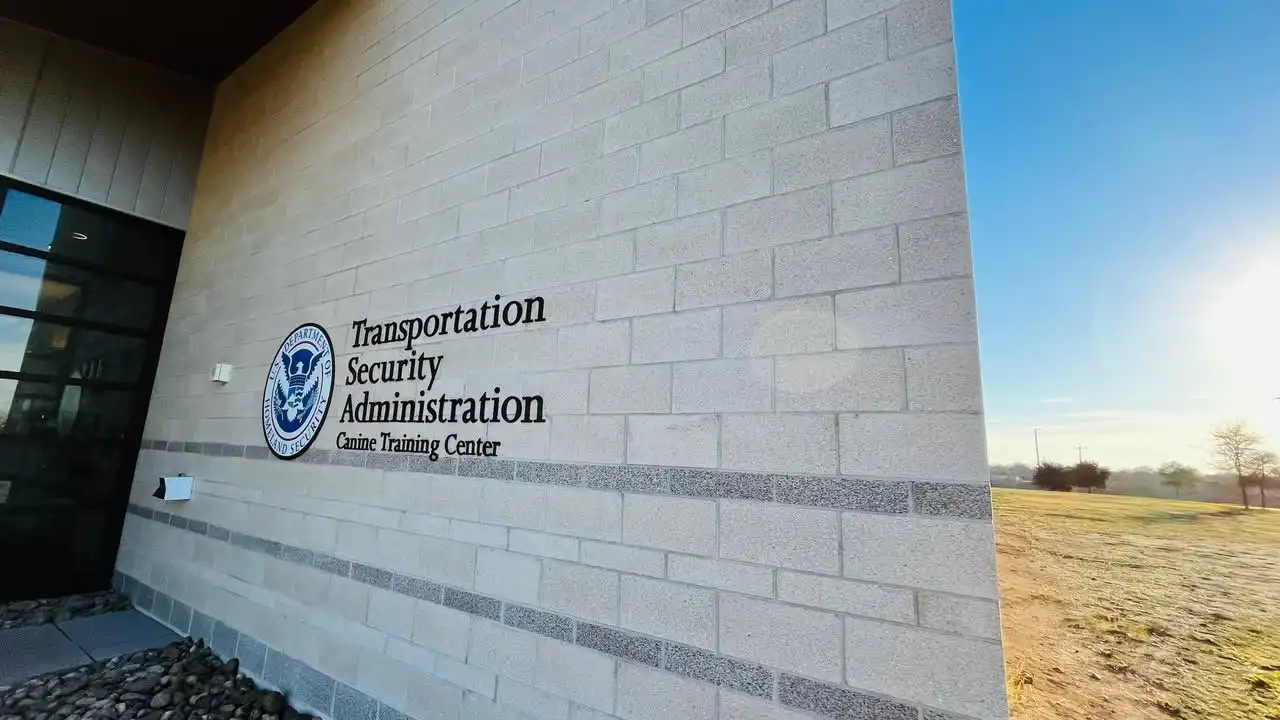
Ever wonder where Transportation Security Administration (TSA) dogs learn the skills that make them one of the agency’s most visible security tools? The answer lies at Joint Base San Antonio-Lackland, Texas, home to TSA’s Canine Training Center.
The $12 million facility spans 25,000 square feet, with seven classrooms, a 100-seat auditorium, and kennels that house about 350 dogs. But its most distinctive feature is its 17 indoor training venues designed to mirror real-world transportation environments. These include airport gates, checkpoints, baggage claim areas, air cargo facilities, light rail cars, and even the interior of a passenger aircraft. The goal is to prepare canine teams for the same challenges they’ll face in the field.
Each year, about 325 dogs complete training, with roughly 160 in training at any given time. Breeds such as German Shepherds, Labrador Retrievers, Belgian Malinois, and Golden Retrievers make up the core of the program. On average, it costs $33,000 to train an explosives detection dog and handler team, and $46,000 for passenger screening teams. Around 83 percent of dogs graduate successfully.
TSA’s National Explosives Detection Canine Program is the largest of its kind within the Department of Homeland Security and second only to the Department of Defense across the federal government. Canine teams, made up of TSA inspectors or local and state law enforcement officers, screen passengers and cargo at more than 100 airports and transit systems nationwide. In 2019 alone, they logged more than 300,000 utilization hours.
Handlers go through intensive training alongside their dogs: 11 weeks for conventional explosives detection and 16 weeks for passenger screening. Teams must demonstrate proficiency in recognizing explosive odors, conducting systematic searches, and working together effectively before graduation. Once certified, the dogs deploy nationwide, serving as both a deterrent and a detection resource across aviation, maritime, cargo, and mass transit environments.
To broaden training, the center also partners with local venues in San Antonio, including the airport, malls, bus terminals, and stadiums, exposing dogs to the same kinds of distractions they’ll face on duty.
With more than 1,000 TSA canine teams deployed nationwide today, these highly trained dogs remain one of the agency’s most effective and mobile tools for detecting explosives and deterring potential threats across the transportation system.
(AI was used in part to facilitate this article.)